Grantee Ruth Moore is making an impact for survivors of sexual assault in the military. Her story was the focus of an article in All You magazine’s November issue. 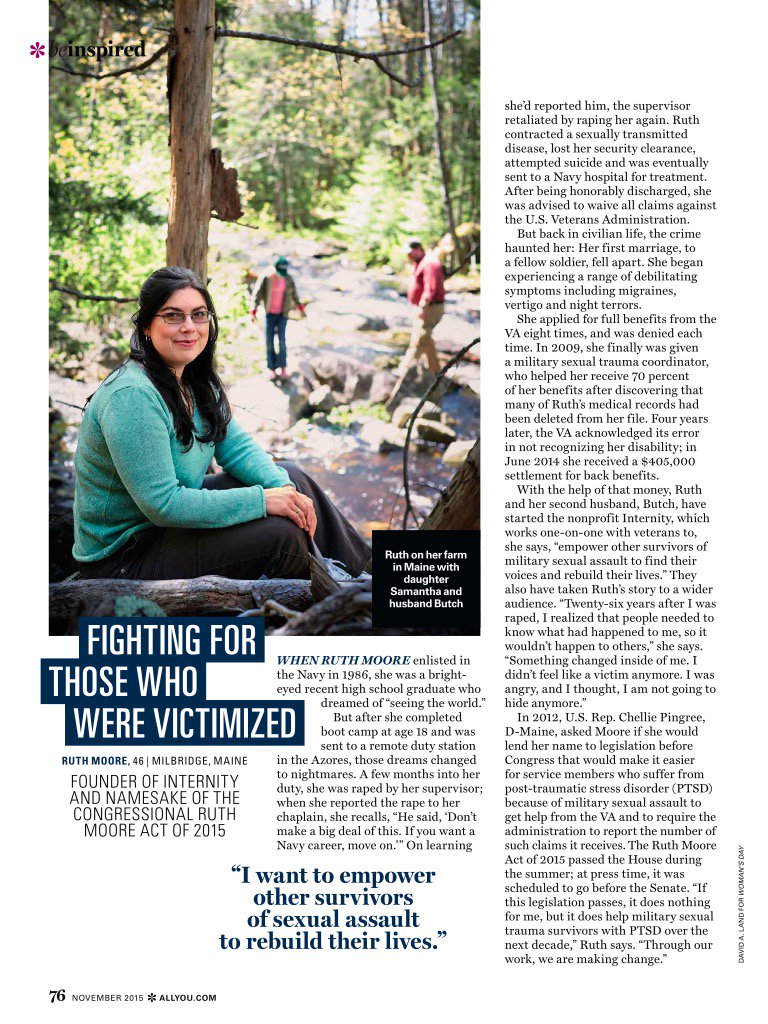
Denver native reaches out through fitness
A psychology major with background as a personal trainer, athletic instructor and support counselor for disabled adults,Jared Ciner channeled these passions into the Spirit Club Foundation with an eye toward creating and opening up
health and fitness opportunities for people with disabilities. Founded in April 2013, the Spirit Club offers group and individual exercise and socially inclusive programming that teach its participants to adopt healthy and active lifestyles.
Ciner was recently introduced to the Good People Fund (GPF) and received an opening grant of $5,000 to support his efforts. GPF is an organization rooted in the Jewish tradition of tikkun olam (repairing the world) and offers financial support and mentorship to small, effective initiatives in Israel and the US.
Ciner grew up in Denver where he attended Jewish day school,was actively involved with the Denver JCC and spent a year studying and volunteering in Israel. He credits his parents’ deep connection to Judaism and their encouragement of Jewish practice and values as having had a huge impact on his life today. His father, Denverite Sheldon Ciner,DDS, is a mohel.
The summer after college, Jared Ciner spent one month in Ethiopia volunteering at a school for children from severely impoverished backgrounds. While there, he organized sports and exercise activities for them. The experience inspired Ciner to pursue a profession that would include fitness for underserved populations. After receiving a BA in psychology from the University of Maryland and certification as a personal trainer, he began working as a support counselor for people with developmental disabilities.
Within one year created the Spirit Club. He now lives in Bethesda, Md. “After speaking to Jared we knew that his unique focus on this type of service for people with disabilities was something we wanted to be part of,” says Naomi Eisenberger, founder and executive director of GPF. Eisenberger had just returned from a visit with Ciner and Spirit Club members. “We support Jared and Spirit Club’s successful efforts to bring access to fitness and overall well being to this often overlooked community.”
Spirit Club members attend hour-long classes each week instructed by at least two certified personal trainers. The classes open with interactive themed exercises that give each member a chance to introduce himself or herself. The activities incorporate different types of fitness equipment, such as medicine balls, resistance bands, stability balls and agility ladders. All members are provided with portfolios to track their progress throughout the week. The classes conclude with a review of home health assignments, healthy snacks and time to socialize and consult with the personal trainers. Spirit Club’s co-founder, Sam Smith, a proud man with autism, is also a certified strength and conditioning specialist. Smith’s goal is to motivate others with his passion and enthusiasm for health and fitness.
Ciner says,“We are excited to now be part of the Good People Fund’s circle of grantees. “The demand for our services continues to increase and this assistance will enable us to offer fitness and health programming to people with disabilities throughout Maryland.”
Information: news@goodpeoplefund.org, www.spirit-club.org
Spirit Club helping people with disabilities be more physically active
As a support counselor at Jubilee Association of Maryland, Jared Ciner worked with the agency to provide services to adults with developmental disabilities. But when he began researching exercise programs for his clients, the University of Maryland graduate came up empty.
“I realized that all of the people I was working with at the agency had being more physically active listed as one of their goals,” Ciner said. “Meanwhile, I couldn’t find any resources or programs to encourage them to participate in or bring them to.”
That’s how Ciner founded Spirit Club. Opened in April 2013, the club offered fitness courses to adults with disabilities to encourage them to eat healthy and exercise regularly. Based in Kensington, Spirit Club has classes in locations in Montgomery and Prince George’s counties and is seeking to expand to Baltimore.
Ciner — who is working with FX Studios, which built the corporate gym for Under Armour, to host classes at the Under Armour Performance Center at 10 Light Street and build a new center in Montgomery County — said he recently attended a Special Olympics conference where parents from Baltimore City and Baltimore and Howard counties packed a standing room-only hall.
“It’s a really big market,” said Ciner, who estimated that he received about 60 information cards from parents expressing interest in Spirit Club.
Ciner, who grew up in Denver before graduating from Maryland with a bachelor’s degree in psychology, said he first saw the value in fitness when he spent the summer after his junior year in Ethiopia, where he organized athletic programs for youth there.
Drawn by the plight of disabled adults, Ciner found a 2010 report from the Centers for Disease Control and Prevention that stated that obesity rates for adults with disabilities are 57 percent higher than rates for adults without disabilities.
“There are no fitness classes for them to participate in unless they’re extremely independent,” Ciner said. “A vast majority of people with disabilities take medication, and a lot of those medications cause weight gain as a side effect. Another reason is that the majority of people with disabilities are unemployed and therefore they’re even less active than the average person who is at least getting up and getting out of the house and going to work.”
Ciner’s first Spirit Club class drew six participants. Now, about 130 clients regularly attend exercise sessions.
“Once I was teaching it, I started to be less surprised [by the growth] because it was just clearly a valuable opportunity for people,” said Ciner, who has teamed with Sam Smith, a marathon runner with autism, and his roommate Justin Frevert to teach classes. “I could just tell that a majority of them had just been craving for an opportunity to exercise, but never had one.”
Ciner’s work caught the attention of Max Levitt, founder of Leveling the Playing Field, a multisport equipment donation business. Levitt recommended Spirit Club to The Good People Fund, and after speaking to Ciner and visiting Spirit Club in October, executive director and co-founder Naomi Eisenberger agreed to award Ciner a $5,000 grant.
“He really hit the bull’s-eye with us because he took his passion for exercise and paired that with what he was doing and working with that population,” Eisenberger said. “From what I saw when I was there, it was a very popular program. The session that I saw was filled with many people with different disabilities, and they all seemed to be having a wonderful time.”
Ciner, who credits his wife, Gabriele, and mother, Anne, for helping him, said he finds daily inspiration from Smith, his co-founder who is a certified personal trainer and a marathon runner despite being autistic. Ciner said he also feels fortunate to work in a job he loves.
“I’ve found a good balance between working hard and making a living and making sure not to lose sight of the mission,” he said. “I find that if I let the mission drive my energy, that leads to positive things and success. It’s a great job and I couldn’t imagine doing anything that would be more fulfilling.”
With nonprofit, Max Levitt connects donors with sports programs in need
A dozen drawings lined the wall next to Max Levitt’s lofted bed in his Syracuse fraternity house.
They came from 12 kids at a small school near the Singita Game Reserve in eastern South Africa that his family visited on vacation. Levitt, a Rockville native, said he had delivered two duffel bags of sporting equipment to the children, whose lone activity before then was chasing one another around the hot blacktop barefoot.
It became the first of many donations for Levitt, who five years later runs a nonprofit that distributes sporting equipment to underprivileged kids in the Washington and Baltimore areas. Levitt believes his organization, Leveling the Playing Field Inc., is the largest multisport equipment donation business in the country.
While the 2010 vacation wasn’t designed as a community service trip, Levitt knew the surrounding villages could use the help. So he reached out to about six high school friends the summer before his senior year at Syracuse to gather as much sporting equipment as he could take on the flight.
“The impact it had on that school and those teachers and those kids was insane,” Levitt said. “Just like how excited they were and how shocked they were to get this stuff. It was so simple to have done for me.”
He had considered working as a sports agent or in public relations, but the expressions on the kids’ faces in the small African village made him reconsider.
“That’s when I first kind of started thinking … ‘maybe this [is] the road I want to go to in sports,'” Levitt said. “I can have security. I can be my own boss. I can do good things for the community. A lot of people focus on the negative in sports, but I can shift the focus to the positive.”
Levitt has watched his idea blossom — the nonprofit has distributed more than $900,000 of equipment to programs in the area since November 2012.
As Levitt sat at his desk as a sales associate at LivingSocial in late May 2013, his cellphone started to ring. He sneaked away to the stairwell, which had become his secondary office, to answer a call that gave him the push he needed to go all in.
On the other end was D.C. United, which had found Levitt online and wanted to do a collection drive with him at a game. At the time, Levitt had been working in sales for about two years, operating Leveling the Playing Field on the side.
“I was like, ‘Wow, I’m not even doing this full time, and it’s grown to the point where a professional soccer team has found me organically and wants to do a collection,'” Levitt said. “It was at that moment when I decided I was doing this full time. I could see that this was going to work.”
He put in his two weeks’ notice at LivingSocial shortly after that phone conversation.
It was a welcome reprieve for Levitt, who had been racing home to his parents’ basement — from which he operated the one-man company — from Chinatown at 5:30 p.m. each day, only to stay up until midnight making spreadsheets, sending emails and calling universities that might become donors and organizations looking for equipment.
“No one was listening to me,” Levitt said. “I hadn’t made any donations. I didn’t have a warehouse. I didn’t have a very good website. There wasn’t a lot to Leveling the Playing Field at that point. It was really still an idea. There was no proof of concept.”
So he invested $5,000 from his savings, using some of the money to buy a dozen plastic bins from Target to set up collections. He designed a website, too. And while he called it “one of the worst websites I’ve ever seen,” it was functional.
He turned his focus from colleges to the local area, calling churches, synagogues, community centers, swimming pools and schools. The bins he set up in the community began to fill up — cluttering his parents’ basement.
“We looked like a Goodwill agency,” said Kay Klass, Levitt’s mother. “We nagged him hard, but he kind of humored us through it. I was very happy when he was out on his own. Not just for myself and being able to see the floor again, but really just that he had a little more organization.”
To this day, people still stop by their driveway — even though Levitt has moved out — to drop off equipment they want to donate. About a year ago, Under Armour showed up at his parents’ house, and Klass answered the door.
They said they had some unsold equipment they were supposed to drop off. She told them Levitt had a 4,000-square-foot warehouse in Silver Spring now, but they could put it in the garage for him to come pick up. The worker then turned and pointed to the semi-truck outside. It wouldn’t fit, they said.
‘Can’t imagine anything better’
With the back of a U-Haul filled to the brim with sports equipment June 9, Levitt drove to Baltimore. About a year earlier, he had made his first big donations in the city, dropping off about $50,000 worth of baseball equipment to James Mosher and Hamilton, two youth baseball leagues.
Levitt said Baltimore was an “obvious expansion.” He said more kids are in need of sporting equipment here, where 86 percent of city students received free or reduced lunch in 2014, according to the Annie E. Casey Foundation’s Kids Count Data Center.
Levitt, who hopes to eventually franchise his business model to reach more cities, estimated he travels to Baltimore once a week, sometimes for meetings with potential clients and other days for drop-offs. And because renting a U-Haul for the 45-minute drive gets expensive — he said it averages about $300 a trip with gas — he tries to plan at least four drop-offs per visit.
The first stop on his June 9 trip was Randallstown High School, where athletic director Michael Gelman said he has about $6 to spend per athlete. With football helmets and pads costing more than $100, it isn’t feasible to provide equipment for students on all the school’s teams.
So, when he got an email about Levitt and what he had to offer, Gelman reached out to Levitt within 30 seconds. About two months later, Levitt was carrying bags filled with basketballs, soccer balls and lacrosse sticks, among other equipment, into a storage room at the school.
“This will open up the eyes of the coaches and the kids,” Gelman said. “This is phenomenal. This a blessing. I don’t know what to say. It will offer us opportunities we haven’t had in the past.”
After making a stop at the Parks and People’s storage unit to receive equipment from sports director David Johnson, who had received equipment from Leveling the Playing Field in the past, Levitt drove to the Druid Hill YMCA. Archie Cumberbatch Sr., a coordinator at the organization, had sent Levitt a wish list, but did not get his hopes up.
Then Levitt arrived with a truck full of equipment.
“I’ve been here for 6 1/2 years, nobody ever donated equipment to us, not like that,” Cumberbatch said. “Maybe an item here or an item there, but not a quantity that we had today.”
Cumberbatch said the YMCA has sometimes had to invent games because of its lack of equipment. That won’t be needed anymore.
“You have individuals that want to create an opportunity for the kids but don’t have the funding or the infrastructure to set something up,” Johnson said. “And then what Leveling the Playing Field does is it kind of eliminates the hurdle of trying to get equipment or uniforms or those little things that may just be the only thing that’s keeping you from really starting a successful program and really impacting the community.”
Levitt said it’s rewarding to hear from a child’s parent or coach, who better understand the long-term positive effect sports can have.
“If you are grinding out there to put dinner on the table and you can’t give your kid something as simple as a glove and a ball, that can’t be a great feeling as a parent,” Levitt said. “So seeing how grateful they are to give their kids that opportunity, for me, is almost more gratifying than seeing the kid’s expression.”
But he’ll never forget those drawings that lined his bedroom wall.
twitter.com/RyanBaillargeon
http://www.baltimoresun.com/sports/outdoors/bs-sp-leveling-the-playing-field-1004-20151001-story.html
New Push For The ‘Strangers In Your Midst’
Tel Aviv — A baby whimpers in a crib and another cries on a mattress on the floor. A toddler nearby spits up his food, but Felicia Fori Koranteng, who runs Gan Felicia, a south Tel Aviv preschool, can’t attend to them because there are dozens of other infants and toddlers in need of her attention.
The two-room preschool, which serves up to 80 children of Israel’s 45,000 to 50,000 African asylum seekers, isn’t funded or regulated by any government agency because the children have no legal status in Israel, even if they were born here. In most cases their births haven’t been documented, and neither they nor their parents — some of them in Israel for more than a decade — receive the universal health coverage Israel provides to its citizens.
The babies and toddlers at Gan Felicia, a place that provides warmth if not attention, are crowded together in one room, the older kids in the other. There are almost no toys in the preschool, and no room to play, so the TV on the wall acts as a babysitter. A small gate keeps the children inside the rooms for their own safety. Their parents work from morning till night, often as house cleaners or food preparers in other cities, so the vast majority of the children are stuck inside the entire day, every day.
Today, though, 14 volunteers, most of them parents and students from the American School, have come to take some of the children out for an hour-and-a-half of fresh air at a nearby park. They’ve brought with them healthy snacks and the desire to give the 14 children they’re accompanying seems to be 14 volunteers and 14 children an abundance of hugs and personalized attention — something the preschool’s three or four full-time caregivers cannot provide.
“We’re about as grassroots as they come,” said Dianne Wier, a volunteer from Texas whose husband, a Lockheed employee, is stationed in Israel for a few years. “Their gan is heartbreaking,” she said, using the Hebrew word for preschool. “The children just crave attention. Here in the park they can run around, something they can’t do at the gan.”
The weekly visit by the American School volunteers is just one of the dozens of grassroots initiatives that have sprung up in Israel to assist the country’s asylum seekers. The projects range from legal aid and health clinics to adult education programs, community meals and women’s cooperatives.
The plight of Israel’s asylum seekers has been making headlines since the refugee/migrant crisis in Europe erupted this summer and Israelis began to debate whether they should provide shelter to some Syrian refugees.
Advocates for Israel’s asylum seekers insist that before Israel can consider taking in additional refugees, it needs to deal humanely with the ones already here.
“These asylum seekers are good, very honest people,” says Gideon Ben-Ami, who, with the help of the New Jersey-based Good People Fund, the Leket food bank, supermarkets and restaurants provides more than 100 tons of rescued food to 12 preschools for asylum seeker children as well as eight families who have been subjected to hate crimes or other traumas.
“For years Israel had an open border with the Sinai and allowed the refugees to come,” Ben Ami said. “They’re already here and we need to take care of them.”
Human rights groups say the Israeli government is making the lives of the asylum seekers, the vast majority of whom cannot be deported according to the United Nations High Commissioner for Refugees, unnecessarily difficult.
Israel “is a reluctant host to 46,437 African asylum seekers predominantly from Eritrea (73 percent) and Sudan (19 percent) and a small minority (8 percent) arriving from several other African countries,” according to the Tel Aviv-based African Refugee Development Center, which relies on volunteers to carry out its services.
The advocacy group says the asylum seekers “are denied basic rights and access to social services, and the government of Israel has employed various policies to pressure asylum seekers to leave.” These policies include indefinite arbitrary detention, refusal to accept and review asylum claims, limitation of access to basic state-sponsored services, incitement and coerced repatriation, according to ARDC.
ARDC notes that Israel’s High Court has twice affirmed that the state’s treatment of African asylum seekers “is unacceptable and violates fundamental laws concerning human dignity and liberty.” The court, it notes, “insisted on a comprehensive policy that seriously tackles this issue, but the government remains non-compliant.”
In response, an Israeli government official said, “the government has explained on numerous occasions its position regarding illegal migrants and will continue to take the necessary steps to address this issue.” Prime Minister Benjamin Netanyahu has framed the issue as one that “is very grave and threatens the social fabric of society, our national security and our national identity” as a “Jewish and democratic state.”
Some groups have successfully petitioned the High Court to release more than 1,000 detainees at the Holot detention camp, a dismal place that houses Eritrean and Sudanese asylum seekers.
Other groups, like Faces of Exile (facesofexile.com), urge Israelis to sign petitions, lobby Knesset members, and volunteer with one of the organizations offering legal guidance, health services, and services to children.
The Hagar and Miriam Program counsels and supports pregnant women during and after their pregnancies. Volunteers include gynecologists, nurses, midwives, doulas, childbirth educators, lactation consultants as well as participants in Jewish Agency programs.
The Schoolhouse (schoolhouse.org.il) provides tutoring and training to adult asylum seekers in Tel Aviv and the Holot detention camp. At the Eritrean Women’s Center (eritreanwomenscenter.org), native Israelis, foreign volunteers and fellow asylum seekers educate female asylum seekers about women’s health issues and domestic abuse.
Last week, the Hartman Institute kicked off a fundraising campaign to establish a day care and learning center for children of African refugees aged 3 to 6. The center, which will be launched in collaboration with the Elifelet organization, which cares for 600 children and infants, will be open from 1:30 to 6:30 p.m. daily. Delivering food and a little spending money to an Eritrean family whose toddler died of malnutrition in Tel Aviv, Ben Ami bemoaned the lack of government services for asylum seekers.
“Four or five asylum seeker children have died from malnutrition. This shouldn’t be happening in a country that is fairly well-off. It says 36 times in the Torah that you should care for the stranger in your midst. How can we so easily forget that we were once the strangers?”
Seated in her one-room apartment, where a curtain separated the family’s beds from two sofas and a kitchenette, Hule Semere, the mother whose 10-month-old son died of malnutrition, said things in Israel are tough but even tougher in Eritrea.
“Here we don’t have health insurance so I couldn’t take the baby to the hospital,” she said. “But in Eritrea the government imprisoned my husband for six years. We can’t go back there until there is a change in government. At least here we can hope for a better future.”
“For You Were Once Strangers,” a documentary on the plight of Israel’s African asylum seekers, will be screened at the Chelsea Film Festival on Friday, Oct. 16 at 6 p.m. at the SVA Theater (333 W. 23rd St.). The screening will be followed by a Q&A session with the director Ruth Berdah-Canet. Chelseafilm.org.
http://www.thejewishweek.com/news/israel-news/new-push-strangers-your-midst
Making better lives, a few dollars at a time
In the Israeli port city of Ashdod, two families with blind babies were eager to take courses at the country’s sole training center for parents of vision-impaired infants. But the center is in Petah Tikva, a three-bus journey from Ashdod, and these families did not have cars. How could they get the specialized guidance they needed?
Their municipal social worker appealed to a new nonprofit, Ten Gav, a crowdfunding site for relatively small needs identified by Israeli social workers and vetted by the two volunteer founders. Following a successful campaign, a van was hired to transport the families to and from the training sessions.
The funding needs presented on Ten Gav never exceed $1,500 (₪5,000), and every dollar donated goes directly to the chosen campaign, so even a small contribution counts large. Since December 2014, Ten Gav has fully funded 80 projects, among them a refrigerator for a destitute family; beds for new immigrants; an air-conditioner for the bedroom of a child with cerebral palsy and a washing machine for an elderly woman.
The founders, Ra’anana residents Vivi Mann and Naomi Brounstein, are professional women with a soft spot for charitable endeavors. They wanted to find a worthwhile project they could start and run together. Mann is a management consultant and Brounstein has degrees in law and social work.
“Ten Gav is all about empowering donors to select the cases their money will go to, and empowering the recipient.”
“Vivi and I looked for challenges that needed to be faced, and we developed this model for the Israeli market based on similar sites operating in America,” Brounstein tells ISRAEL21c.
They began Ten Gav as an online crowdfunding platform to match donors with modest needs in Israel that cannot be funded by the state or existing charities. “We are very careful not to present stories where another organization can easily provide what is needed,” says Brounstein.
With startup capital from supporters including Joseph Gitler, founder and head of the Leket Israel national food bank, they began making contact with municipal social workers across Israel.
They weren’t quite ready to launch when the 2014 summer conflict with Hamas escalated into Operation Protective Edge. But a Canadian friend of Brounstein’s wanted to make an immediate donation to families affected by the rocket fire, and asked if she could do so through Ten Gav.
“So we built our first site using Wix as Vivi ran around to communities in the South to find needs from social workers,” says Brounstein. “Sderot social workers deal with a lot of elderly residents, and we filled a number of requests for air conditioners and washing machines. This was not a directly war-related need, but in times of uncertainty and insecurity, any help you give goes a long way in making people feel they are supported by others.”
Seeing things others don’t
After the ceasefire in late August, the women took Ten Gav offline until they truly felt ready to launch at the end of the year.
“Ten Gav is all about empowering donors to select the cases their money will go to, and empowering the recipient,” says Mann.
Many of the causes brought to their attention by social workers don’t fall under the rubric of traditional charity. For example, a social worker in one city thought that joining an afterschool soccer program would help two boys in therapy to release their aggression in a fun and disciplined manner, and that they would benefit from being part of a team. Since their parents could not afford the fee, Ten Gav raised it and the boys were able to join.
The two founders say they are impressed by the sensitivity and creativity of the welfare authorities they meet in each municipality. “They see things in homes that you and I do not see,” says Brounstein.
Sharon Friedman, a social worker in the Department of Youth at Risk of Jerusalem, describes Ten Gav’s assistance as “oxygen to breathe” for some of her clients. Among requests her office has submitted and that have been successfully crowdfunded are piano lessons for a girl whose family could not afford them, a ping-pong table for a child with social difficulties, an afterschool program for a child from a single-parent home, and a computer to enable a woman to work from home.
Checks are made out to the service providers and handed over by the social workers. All administrative costs are covered separately by grants from supporters such as the US-based Good People Fund.
“We are looking to expand slowly so we can control the types of cases and level of due diligence we can do so our donors can always be confident their money is going to the right place,” says Brounstein.
Mann explains that the name “Ten Gav” was chosen for a few reasons. The expression loosely translates to “watch my back” and portrays the idea of helping out rather than handing over cash. “Everybody gives something and gets connected to a personal story, knowing their money won’t get lost in a big pool.”
For more information, click here.