• Skip to primary navigation
  • Skip to main content
  • Skip to primary sidebar
  • Skip to footer
 
LOG-IN
DONATE NOW
SUBSCRIBE
The Good People Fund

The Good People Fund

  • About
    • Mission and Vision
    • Values
    • Plan for Good (Our Strategic Plan)
    • Our Story
    • Professional Leadership
    • Board of Trustees
    • Financial Information
    • Privacy Policy
    • FAQ’s
    • Contact Us
  • Our Grantees
    • New Grantees
    • By Program Focus
    • By Location
    • By Organization
    • Alumni Grantees
  • How to Help
    • Donate Now
    • Acknowledgement Cards
    • Planned Giving
    • Charitable Solicitation Disclosure Statement
  • Learning
    • Our Educational Philosophy
    • For Jewish Educators
      • Our Good Service Model
      • Grab ‘n’ Go Lessons
      • GPF Core Curriculum
      • B’nai Mitzvah Service Projects
      • Archival Materials
      • Ziv Tzedakah Curriculum
    • For Students
      • Tips for Good Service Projects
      • Other Resources
  • Media
    • Newsroom
      • Grantees in the News
      • GPF in the News
      • Press Releases
      • 10th Anniversary
    • Grantee Focus
    • Videos
  • Good News
    • Good News Stories
    • Executive Director Messages
  • Podcasts
  • Journal of Good
    • Journal of Good
    • Stories of Hope
    • Journal of Good – Prior Years
You are here: Home / Archives for News

‘We can’t stop’ – the Israeli woman still helping sick Palestinians

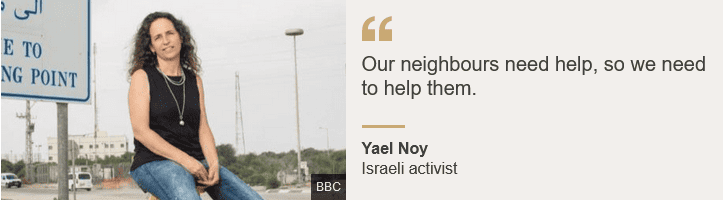
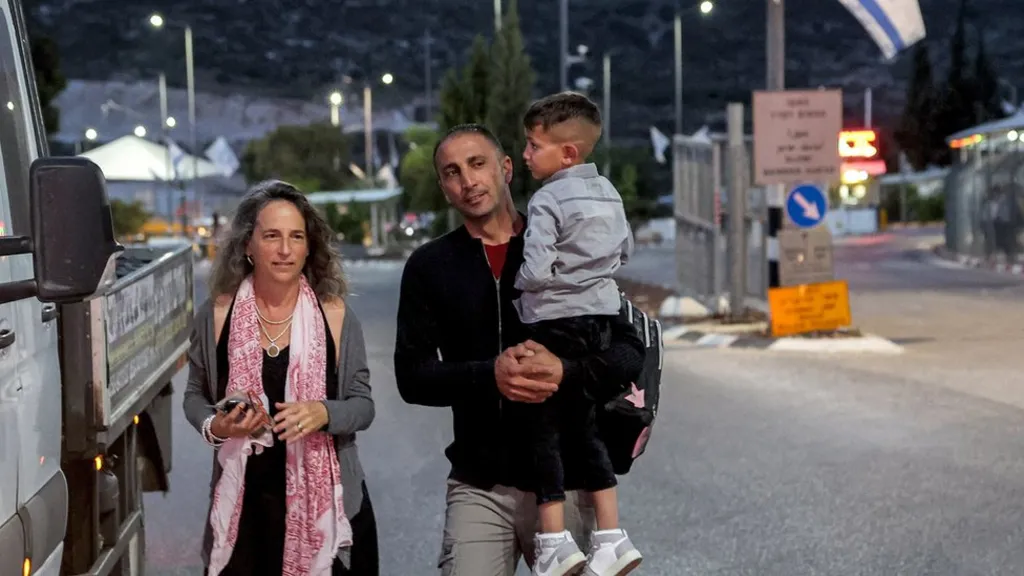
Yael Noy (left) drives sick Palestinians, mostly children, across checkpoints to hospital appointments in Israel

Yael Noy doesn’t wear military fatigues, but she describes herself as being in battle right now, after the Hamas assault on 7 October.

“I’m fighting to be good,” she tells me. “I’m fighting to stay moral when both sides are in such terrible pain. I’m fighting to be the same person I was before.”

Yael heads a charity called Road to Recovery, a group of Israeli volunteers who drive sick Palestinians – mostly children – from checkpoints in the occupied West Bank and Gaza to hospital appointments in Israel.

Or did.

The 1,000 or so volunteers can no longer take patients from Gaza, which is governed by Hamas. And four of them are dead – murdered as Palestinian gunmen stormed through their kibbutzim in southern Israel.

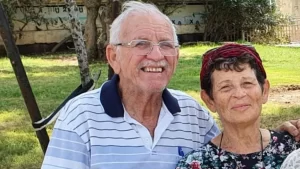
They include Vivian Silver, a renowned peace activist; Adi Dagan, who Yael describes as “funny” and always ready to step in and ferry patients at short notice in his big car; Tammy Suchman, a much-loved grandmother; and Eli Or-Gad, who loved talking about poetry.

Four other volunteers lost close family members on 7 October.

About 1,200 people were killed in the Hamas attack on Israel. Since then, Gaza’s Hamas-run health ministry says more than 17,177 people have been killed in the Israeli offensive which followed.

Yael lives in northern Israel, but her parents are from kibbutz Alumim, one of the southern communities which was attacked – and they cowered as the assault unfolded, hour after terrifying hour.

Two of her nephews have been fighting in Gaza, in Israel’s military response.

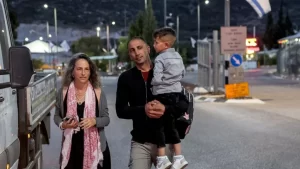
Yael Noy’s parents were in one of the kibbutzim attacked by Hamas on October 7 and are now displaced

In the immediate aftermath of 7 October, Yael says she was so shaken that she could barely breathe.

“Something was broken in my heart and I said that I would never talk to people in Gaza again,” she tells me.

But after a few days, she decided that she couldn’t allow the atrocities to change her.

She and most of the Road to Recovery volunteers have continued to drive Palestinians from the West Bank to hospitals in Israel for cancer treatment, organ transplants and kidney dialysis. As soon as she can, she says she’ll go and collect patients from Gaza again.

Yael refuses to dehumanise them, or equate them with Hamas, which is classed as a terrorist organisation in the UK and other countries.

“Like us they are victims of Hamas, so I think we should keep on helping them, because it’s not their fault,” she tells me over the phone.

“We can’t refuse to help a child with cancer. Our neighbours need help, so we need to help them.”

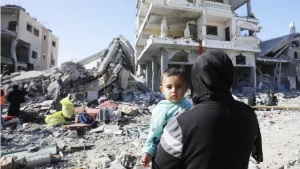
She worries for the families she knows in Gaza, with winter approaching and so many bombed houses now uninhabitable.

The parent of a 6-year-old child, who’d had an organ transplant, texted one of the Road to Recovery volunteers saying simply: “We are okay. We are going to die here.”

After one week of truce, bombing over Gaza resumed on Friday

Yael is also desperately concerned for two Road to Recovery volunteers, Oded Lifschitz and Chaim Peri, who are still being held hostage by Hamas.

Emotionally, she feels like she’s being torn apart. She has uncles and cousins who are adamantly opposed to what she’s doing and accuse her of helping Hamas.

And it’s not just family members who disapprove.

“When I’m driving with Palestinians through checkpoints in the West Bank, soldiers have asked me how I can do what I’m doing,” she tells me. “Other people ask the same question.”

“It’s dangerous now to even talk about the suffering of the kids in Gaza – people look at me like I’m the enemy,” she says, through sobs. “But I’m not doing it for the Palestinians, I’m doing it because I want to be proud to be Israeli. I believe that whether you’re an Israeli or a Palestinian, a Jew or an Arab, people are people.”

Some Palestinian families have reached out to find out how she is. But it’s harder than ever now for those few people swimming against the tide by trying to bridge the divide between Israelis and Palestinians.

“Even people on the left say that we should flatten Gaza. Both sides have become more and more radicalised,” Yael says.

“I really don’t know what will happen in the future. But I know that both of us will still live here, so we must find a solution.”

Since 7 October, some Road to Recovery volunteers have dropped out of driving altogether or decided to focus on taking medicines to displaced Israelis instead, while the war lasts.

But other volunteers have stepped in, to make sure that sick Palestinians from the West Bank still get to appointments that are saving their lives.

Yael says the charity will need support from the outside world to keep going because donations from within Israel have virtually stopped.

But she is sure that, when it becomes possible, Road to Recovery will be collecting child patients from Gaza again – hoping that they will all have survived.

“It may be hard. But we can’t stop,” she says. “It’s my mission and I have to do it.”

At 19, I Was Forced To Marry A Stranger And Was Sexually Assaulted Every Month For 12 Years

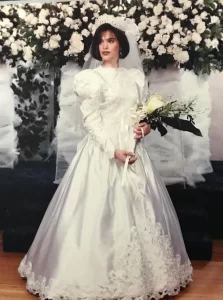
The author on her wedding day. “I was a 19-year-old bride, in the world’s ugliest turtleneck gown and the world’s ugliest wig,” she writes.Courtesy of Fraidy Reiss

Note: The following essay contains descriptions of sexual assault and abuse.

They sent me off to be raped, with a party and a tube of K-Y Jelly.

The lubricant was to reduce the intense physical pain they explained I would endure while being penetrated by a stranger-turned-husband, without foreplay, without consent. Every month. Until death do us part.

The party — a low-budget wedding in 1995 at a Brooklyn venue aptly nicknamed Armpit Terrace — was to distract me from the horrific reality of my forced marriage to the stranger.

“Mazel tov!” they told me, beaming.

In the reclusive Orthodox Jewish community in New York City where I grew up, choices about whether, when and whom I would marry did not belong to me. At home and at the all-girls religious school I attended, where I learned to cook and sew and keep house, I was groomed from early childhood to expect a teen marriage to a stranger my family and a matchmaker would choose for me.

I was allowed to meet the stranger several times before my engagement, but I was not allowed to be alone with him nor to have any physical contact with him. I was a clueless 19-year-old who had never been allowed to “talk to a boy,” and suddenly I was given a matter of hours, over a period of a few weeks, to answer my family and his family and the matchmaker and everyone in the community standing there, tapping their feet, looking at their watches, waiting for me to tell them: You’ll marry this man we chose for you, right?

“No” was never really an option.

During my six-week engagement, I still was not allowed to be alone with the groom nor to have any physical contact with him, which left more time for me to begin experiencing the myriad other abuses that come with a forced marriage.

First, a virginity exam. The groom’s rabbi sent me to an Orthodox Jewish gynecologist, where I was instructed to disrobe, get on the examination table and put my feet in the stirrups. The doctor inserted her gloved fingers into my vagina and confirmed that my hymen was intact.

“Mazel tov!” she told me, beaming.

I attended one-on-one bridal classes, where the curriculum centered on the requirement that I have unprotected sex with my husband on my wedding night and on a monthly basis thereafter. A lifetime of rape.

Yes, the rapes probably would hurt, the bridal class teacher explained. Hence the K-Y Jelly.

“Mazel tov!” she told me, beaming.

My stranger-turned-husband turned out to be violent and abusive. I learned this exactly one week after our wedding, when he became enraged because he had woken up late, and he punched his fist through the wall — hard enough to leave a sizable hole.

His first threat to kill me came only days later. Soon these threats became more frequent, specific and gruesome. He was brimming with creative ideas for how he would end my life, and he took the time to describe them to me in vivid detail. A lifetime of fear.

Yet I was trapped.

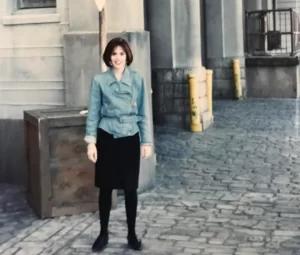
“Me as 19-year-old newlywed, in clothing four sizes too big,” the author writes.Courtesy of Fraidy Reiss

My forced marital sex was carefully timed each month for when I was ovulating. The reason for this was obvious: My first child was born 11 months after my wedding, and soon I had a second child.

I love my daughters, but I did not consent to having them. A lifetime of forced parenthood.

This denial of sexual and reproductive rights was not the only shackle preventing me from leaving my marriage. My husband did not allow me to have my own bank account or credit card, and I was taught that, under Orthodox Jewish law, if my husband allowed me to work, any money I earned belonged to him. A lifetime of domestic servitude and financial dependence.

I had limited legal rights too. Under Orthodox Jewish law, only a man can grant a divorce. I, as a woman, did not have the legal right to end my own marriage. A lifetime of being locked in unwanted wedlock.

One escape route for me would have been to move back in with my family as an agunah, a “chained woman” who is bound to a husband who refuses her a divorce. The life of an agunah is brutal; she is shamed for her powerlessness, blamed for her failed marriage and treated as an outcast.

But even this dreadful escape route was closed to me, because my family refused to take me back in. A lifetime of betrayal.

So I remained trapped in my abusive forced marriage. In accordance with Orthodox Jewish law, I was considered “unclean” every time I menstruated. While I was “unclean,” I was prohibited from having physical contact with my husband, sleeping in the same bed as him, handing him anything or undressing or singing in front of him. A lifetime of shame.

Once my period ended, I needed to count seven “clean” days without any menstrual blood, during which time the rules against physical contact continued. To make sure I stayed “clean” for the full seven days, I was required to wear white panties and, twice a day, to insert a white cloth into my vagina, swish it around and inspect it in sunlight to make sure it did not have blood spots. If I found questionable marks on my panties and could not tell whether they were blood, the rabbi would inspect them and give his pronouncement.

And the rabbi would keep my panties. A lifetime of extreme patriarchy.

Each month, after the seven “clean” days, I was forced to strip naked in front of an attendant who watched me immerse in a mikvah, or a ritual bath of rainwater, which frequently left me with a yeast infection and always left me shaking uncontrollably. A lifetime of violation.

All I wanted, every time I left the mikvah, was to take a hot shower and scrub the violation off me. That was prohibited. Instead I was required to go home and have nonconsensual sex with the man who had spent the day describing to me in graphic detail how he was going to murder me. The man who would not let me close the door when I used the bathroom, because “what was I hiding from him in there?”

No matter. I had to get on the bed and spread my legs and forget what had happened to me at the mikvah and ignore the pain while I waited for him to finish, and I had to remind myself how lucky I was that he usually was done after only three or four thrusts. A lifetime straight out of Margaret Atwood’s “The Handmaid’s Tale.”

Forced marriage — in which one or both parties do not give full, free consent — is recognized globally as a form of modern slavery. My story is far from unique: Around the world, 22 million people were in a forced marriage as of 2021.

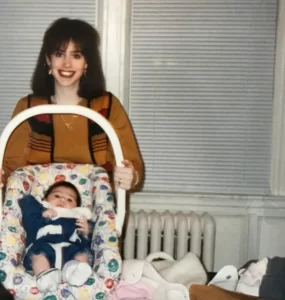
“Me as a 20-year-old mom, in the world’s second-ugliest wig,” the author writes.Courtesy of Fraidy Reiss

Yet, even though the United States acknowledges that forced marriage is a human rights abuse, few laws and policies are in place to prevent or punish it, and the nation has paid such scant attention to this issue that we do not even know how often forced marriage happens here.

What’s more, child marriage remains legal in most U.S. states, even though it is recognized as a form of forced marriage and a human rights abuse. Some 300,000 children were married in the U.S. between 2000 and 2018, mostly girls wed to adult men. At least 60,000 marriages occurred at an age or with a spousal age difference that should have been considered a sex crime.

My husband would regularly search through my personal belongings in front of me, including in the pockets of the clothing in my closet and in my bag of tampons under the bathroom sink. A lifetime of subjugation. When I finally realized at age 27 that I was the only person who would help me leave my abusive forced marriage alive and I decided I would secretly save up cash for my escape, I found the only safe hiding place in the house: a box of Whole Grain Total in the pantry.

I saved more than $40,000 in that cereal box over the next five years.

During those years I also defied my community and did something no one in my family had ever done: I became a college student. My husband forbade me from attending classes. I informed him, calmly, that nothing he did to me would stop me from getting my education.

And I did something no one I knew had ever done: I threw out the limp, ugly wig I was required to wear as a married woman to cover my own thick, healthy hair. I walked outside with my uncovered head held high — the equivalent, in that community, of walking outside naked.

My family retaliated immediately by shunning me. One of my sisters notified me that my family was planning to sit shiva — or observe the Jewish mourning ritual for me — as if I had literally died. I have had almost no contact with my family since that day. A lifetime of being dead.

But I graduated from Rutgers University (as commencement speaker, the equivalent of valedictorian) at age 32, and I escaped my abusive forced marriage on my own, with my daughters and my box of Total. I fled the Orthodox Jewish community too, and I rebuilt my life.

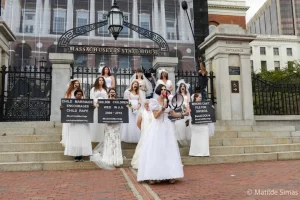
The author leading a chain-in protest in Boston against child marriage in 2021.Photo by Matilde Simas

In 2011 I founded a nonprofit organization, Unchained At Last, to combat forced and child marriage in the U.S. through direct services and systems change.

The U.S. is one of 193 countries that agree forced and child marriage are harmful practices, particularly for women and girls, and have promised to eliminate these abuses by year 2030 to help achieve gender equality, under the United Nations Sustainable Development Goals. Yet the U.S. is not on track to keep its promise.

I refuse to accept this. Not after I escaped my lifetime of oppression.

We at Unchained are fighting back by providing crucial wraparound services to a long-ignored population: those who are fleeing an existing or impending forced marriage in the U.S. To date we have provided legal and social services, always for free, to nearly 1,000 individuals, to help give them a lifetime of dignity, safety and hope.

We also started a national movement to end child marriage. In the last few years, our groundbreaking research and relentless advocacy have allowed us to help change the law in 10 U.S. states to ban child marriage — a stunning victory for the 7.5 million girls who live in those 10 states — and we are working on the other 40.

A lifetime of preventing other lifetimes of rape.

“Mazel tov!” I now tell myself, beaming, with each triumphant step closer to ending forced and child marriage in the U.S.

Fraidy Reiss is a forced marriage survivor turned activist. She is the founder and executive director of Unchained At Last, a survivor-led nonprofit organization working to end forced and child marriage in the U.S. through direct services and systems change. Fraidy’s research and writing on forced and child marriage have been published extensively, making her one of the nation’s foremost experts on these abuses. She has been featured in books (including as one of the titular women in Hillary and Chelsea Clinton’s “The Book of Gutsy Women”), films and countless television, radio and print news stories.

New initiatives look to help Jewish teens connect to themselves and their community before becoming adults

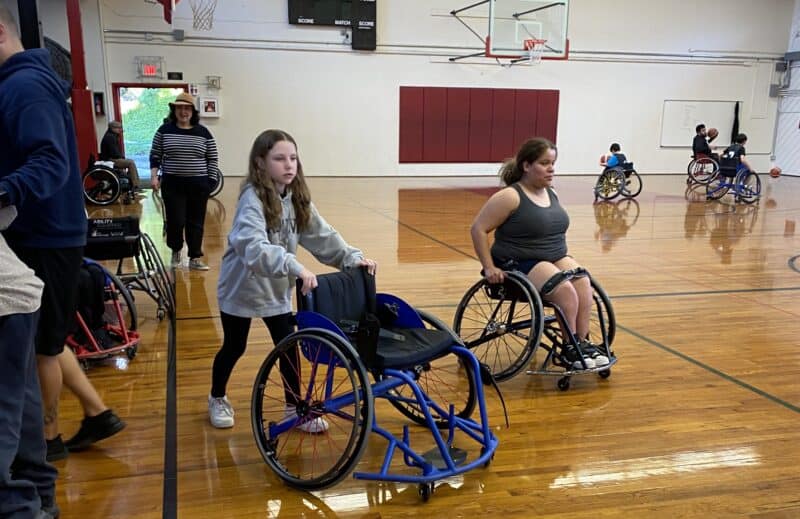
Olivia Bakal (left) volunteers at a wheelchair basketball clinic for Angel City Sports in Los Angeles as a part of her bat mitzvah project.

When Elie Klein was 13, he knew that giving back meaningfully and making a mark on the community was part of becoming a Jewish adult; this translated to donating about a tenth of his gift money to charity, he told eJP. But today’s “mitzvah project model” is more effective as an educational tool, he said, “because it highlights personalization and promotes advocacy and action.”

Now the North American director of development at ADI, an organization that cares for and empowers Israelis with disabilities, Klein listed some of the ADI-based projects that b’nai mitzvah have participated in: twinning with an ADI resident of a similar age, running bake sales, bike-a-thons and other small-scale fundraising projects to help the organization secure equipment, therapies and opportunities for those who benefit from ADI’s services, adding that these experiences will enable young leaders to “choose their own adventures.”

As Jewish youth learn the cantillation for their Torah portions, worry about the notes of the haftarah and navigate the social pressures of the parties, they are also giving back to their communities as part of their b’nai mitzvah training, raising funds and awareness for favorite causes or new initiatives, learning new skills and developing their passions.

The mitzvah project has even been in the pop culture spotlight recently: “You Are So Not Invited to My Bat Mitzvah,” which debuted on Netflix in August and is still a subject of conversation in the Jewish community, featured a throughline of protagonist Stacy’s search for a mitzvah project that spoke to her. The film portrays the mitzvah project as a one-off event, more like a single good deed. Stacy considers making friendship bracelets for dogs or volunteering at a retirement home (where her crush just happens to regularly visit his grandmother). But Rabbi Rebecca, Stacy’s quirky, tough-love-wielding Hebrew school teacher, tells her that “the sooner you do your mitzvah, the sooner you’ll find things falling into place.”

“Mitzvah projects are the norm in hundreds of Reform, Conservative, Reconstructionist, and Renewal communities, but very few synagogues dictate the exact nature of the mitzvah project,” Rabbi Daniel Brenner, vice president of education at Moving Traditions, told eJP. He explained that the “project” designation encouraged students to do something beyond writing a check to charity, and gave it additional visibility by making it a part of the d’var torah or b’nai mitzvah speech.

Rabbi Jason Miller, who has been officiating private and customized bar and bat mitzvah ceremonies for more than two decades, told eJewishPhilanthropy that the mitzvah project can be a space to be creative and discover new passions. When in-person volunteering was not possible during the pandemic for health reasons, Miller said, two students whose b’nai mitzvah were a month apart joined forces on their mitzvah project: they volunteered to cook food for parents staying at a Ronald McDonald House in Ann Arbor, Mich., whose children were in treatment at a nearby hospital.

“The problem was that neither of these boys had ever cooked before,” Miller said. “They were determined, though, and spent hours learning how to cook by watching YouTube videos and then made breakfast on several occasions for dozens of parents at the Ronald McDonald House. These two boys loved the mitzvah project so much and they both love to cook now. They just never realized it was a passion.”

Elana Beame, who spearheads the mitzvah project program at Tzedek America, recalled a student in Southern California who was extremely passionate about food waste. “He learned how grocery stores and markets will throw away produce no longer at selling standards. This produce was still completely edible. He took the initiative to go to his local grocery stores, markets and farms and started rescuing the produce that would be thrown away and instead donated them to local food banks,” Beame said. “He used rescued produce to create table centerpieces at his celebration, which were then donated to a food bank immediately following the party.”

This week, Tzedek America founder Avram Mandell spoke with a student who has the Torah portion of Bo, which talks about the plague of darkness. “We talked about vulnerable populations and the connection to feeling vulnerable during the plague of darkness, and she connected darkness to depression and no one wants to feel that kind of sadness,” Mandell said, adding that this framework “made her feel more inspired to work with the vulnerable population she chose.”

Todd Shotz, founder of b’nai mitzvah prep company Hebrew Helpers and the Mitzvah Learning Fund, which provides grants for Jewish learning opportunities, said that his organization’s students are encouraged to pick an ongoing project, to “use this moment as a launching pad for a life dedicated to tikkun olam.”

“Our mentors frame it as the student putting their new role as a fully responsible member of the community into action,” he told eJP. Hebrew Helpers also asks its students — now more than 1,200 b’nai mitzvah trained — to go beyond fundraising and actively volunteer for their chosen cause if possible. “It is always engaging to a student if the charitable cause is centered around an interest or passion of theirs,” Shotz said, recalling students who knitted baby blankets for the local children’s hospital; made and gathered dresses for Dress For Success; and made dog toys and raised money for the Israel Guide Dog Center.

Many Jewish programs preparing students for their b’nai mitzvah require that they complete their community service commitment by the date of the synagogue service, as if the project is just another to-do on the b’nai mitzvah checklist, which may not encourage longer-term engagement with the cause in question. And some families do opt out if volunteering is not required.

At Congregation Beth El in Bethesda, Md., Robin Finkelstein, b’nai mitzvah coordinator and hazzan assistant, said her synagogue strongly encourages students to participate in mitzvah projects, but does not require it — of this year’s 26 b’nai mitzvah students only 13 have reported mitzvah projects, “definitely a drop from last year,” she said. This year’s projects included helping new immigrants, cooking meals at an interfaith center, collecting toys for a hospital pediatric unit, raising money for The Trevor Project, supporting an education nonprofit for kids with disabilities and park cleanups.

Making mitzvah matches

From 2000-2013, longtime Jewish educator Sheri Gropper had a thematically appropriate 13-year run helming “Mitzvah Mania” fair, where families would receive a packet of materials, listing various nonprofits grouped by areas of interest with contact information and ideas for helping them. The fair would draw more than 130 families of pre- bar/bat mitzvah students per year, she told eJP.

Today’s technology enables a different approach, but today’s students and their parents still need help to find their mitzvah project match: enter Tzedek America’s Mitzvah Project Central, a password-protected database of partner organizations that have volunteer opportunities available for b’nai mitzvah-aged students. The opportunities are tagged by topic and shown on a map (some of them are marked as opportunities that can be done from anywhere).

“If a student comes to us and is unsure of what social justice topic to focus on, we explore the different options together, or we look at their Torah portion for themes that can be connected to a social justice topic,” Beame said. “Students tend to want to focus on organizations that are in their backyard so they can volunteer in a hands-on way. We encourage the students to look at all of the organizations we partner with, regardless of location, to get inspired and learn more about what different regions focus on.”

Also helping teens find meaningful mitzvah matches, the Atlanta-based Creating Connected Communities (CCC) started as a bat mitzvah project 25 years ago, when Amy (Sacks) Zeide organized a small holiday party for a local shelter.

“The theft of kids’ Christmas presents from a local Atlanta agency inspired Amy to use bat mitzvah gift money to create Amy’s Holiday Party, an annual event that brings local kids together for a fun day of games and music, and to distribute holiday gifts their families might not be able to afford,” Naomi Eisenberger, the executive director of Good People Fund, told eJP. “This annual party is a key activity for CCC teen participants,” she added.

Today, CCC is an independent 501(c)(3) and builds community, provides Jewish teen leadership training and guides young teens, synagogues and other groups in creating meaningful mitzvah projects. A division of the organization, Amy’s Holiday Party, pays tribute to the original project, but now serves thousands of children and families in need year-round, and engages hundreds of teens in hands-on volunteer work.

“As a community, we want giving to become a central part of our young leaders’ identities, and the best way to achieve this is by plugging into what they are already passionate about,” Klein said. “We empower them to use what they love to rally their communities around the cause and help us make a profound impact for disability care and inclusion. In addition to providing the perfect recipe for self-motivation, this method also ensures the greatest possible satisfaction, as teens are excited to be the ones running the show and imparting knowledge and values to the adults in their lives.”

By recycling equipment, this nonprofit puts youth sports in reach

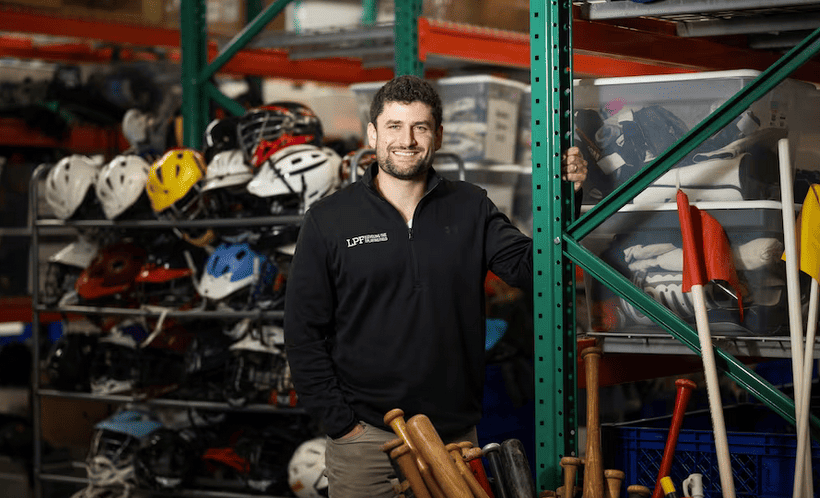
Max Levitt founded Leveling the Playing Field after his experience as a student assistant for the Syracuse football team. (Craig Hudson for The Washington Post)

Fifteen years ago, Max Levitt was a freshman at Syracuse University who chose to major in sports management for one reason: It had the word “sports” in it. Students were told that the key to getting a post-college job in the sports industry was to work wherever they could in the sports industry. Levitt became a student assistant in the football team’s equipment room.

There, every August, the equipment staff would arrive before the players and begin the process of replacing the old with the new.

“We were literally taking millions of dollars’ worth of product — footballs, gloves, cleats, socks, everything you could possibly imagine — and we were literally throwing that stuff into dumpsters to clear out space,” Levitt said. “ … I was like: ‘This doesn’t make any sense. Why are we doing this?’ ”

On Wednesday night in Washington, Levitt will join all manner of friends, colleagues and donors to celebrate the 10-year anniversary of Leveling the Playing Field, the nonprofit he founded after college largely based on his experience there. Levitt figured there were food banks and diaper banks. There are centers where those in need could get donated furniture or clothes.

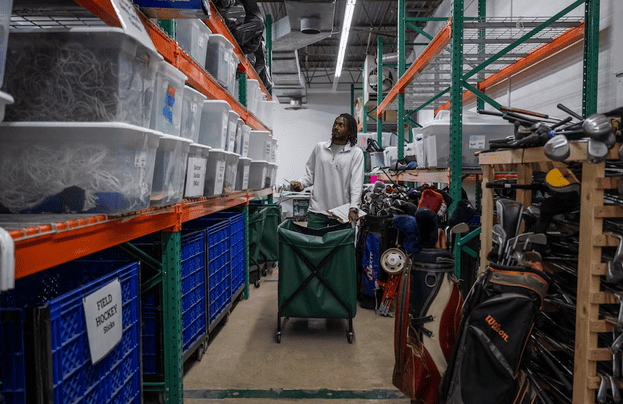
Leveling the Playing Field has a 5,500-square-foot warehouse in Silver Spring filled with old sports equipment. (Craig Hudson for The Washington Post)

“Those types of organizations exist in every major market, even mid-markets, across the country,” Levitt said. “They’re really effective at what they do. And I thought, ‘Gosh, why can’t we do the same thing for the youth sports industry?’ ”

Levitt has done it and is doing it, and his organization is worth watching. The concept is simple: There is a growing and obvious inequity in the burgeoning world of youth sports, preventing underserved communities from opportunities. Addressing it takes vision and work. For the people who benefit, Leveling the Playing Field is making an immediate impact.

“I went to this warehouse, and they had this endless amount of different supplies,” said Brian Cross, a physical education teacher at Ida B. Wells Middle School in the District. “They had golf equipment, so I was like, ‘Ooh, I’m going to have a golfing unit.’ They had baseballs, softballs, gloves. ‘Ooh, I’m going to have a baseball and softball unit.’ They had tennis balls. ‘I’m going to create that.’

“I was like a kid in a candy store. With all this equipment, the kids were able to experience all sorts of different sports.”

To this point, Levitt said Leveling the Playing Field has distributed somewhere between $13 million and $14 million of equipment among 2,500 to 3,000 schools, rec programs and leagues. There are plans for much more.

But before exploring where the organization is going, it helps to understand where it started. Levitt grew up as a sports-obsessed kid in a Bethesda family with a charitable bent. Small acts of kindness were baked into his upbringing. His mother would make sandwiches, and they would take them to homeless people. That trains the mind to think a certain way.

So by the time Levitt was back home working summer internships — with Washington’s NFL team, with the minor league Bowie Baysox, with Montgomery County’s department of recreation — his experience at Syracuse had shown him excess, and his experience at home showed him inefficiency and need.

“I was always poking around the equipment side of these different jobs and noticed — whether it was youth sports at the elementary school level all the way up to college or professional or minor league baseball — there was just a huge amount of sports equipment that was either being thrown away or just sitting in sheds, garages or closets collecting dust,” he said. “At this point I was like: ‘Wow, there’s an opportunity here. There’s a huge kind of untapped potential here on the secondary market with sports equipment.’ ”

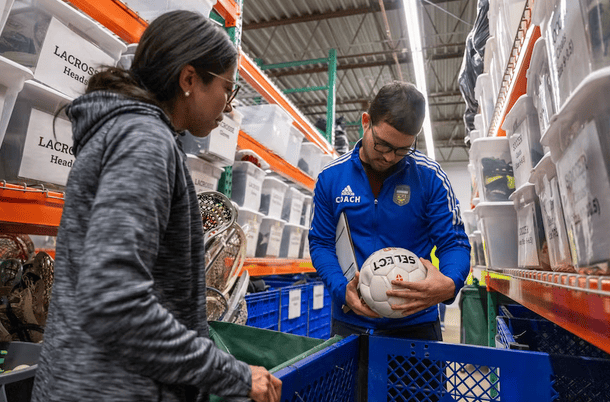
Leveling the Playing Field has distributed somewhere between $13 million and $14 million of equipment among 2,500 to 3,000 schools, rec programs and leagues. (Photos by Craig Hudson for The Washington Post)

Levitt graduated from Syracuse in 2011 and took a job in sales, making cold calls. But to scratch his volunteering itch, he tapped into that sports equipment experience. After failing to land leftover goods from the major collegiate athletic programs locally, he realized, “This is a credibility issue.” To gain credibility, he needed to show some record of success. So he bought a dozen plastic bins, put some crude labeling on them and dropped them at churches and synagogues and the like.

“The amount of stuff that would come in from just these little tubs being put out at a church or community center was insane,” Levitt said.

Levitt began storing equipment in his parents’ basement. He started receiving emails from people wanting to donate, to volunteer, to collect equipment on their own. D.C. United invited him to run a collection drive at one of its games. Youth leagues reached out. Some drives were big enough that he had to rent trucks. The Bethesda basement was becoming too small. In two years, Levitt realized: “This is no longer feasible for me to do as a side project.”

It is no longer a side project. Leveling the Playing Field has an office in the District, fills a 5,500-square-foot warehouse in Silver Spring and has branched out to Baltimore and Philadelphia with openings coming in Buffalo and Columbus, Ohio. It has 14 full-time employees. This year alone, Levitt expects the operation to distribute $4 million worth of sports equipment.

“During covid, when the students were at home, they didn’t really have access to materials,” said Miriam Kenyon, the director of health and physical education for D.C. Public Schools. “That’s where Leveling the Playing Field really jumped in to provide additional support. … To be able to see the students doing stuff, even though it was virtual and in their own space, that was really, really good. It kind of circled back to exactly what their name is.”

Bryan Trueblood, athletic director of Bladensburg High, carries away equipment he has picked out at the Leveling the Playing Field warehouse in Silver Spring. (Craig Hudson for The Washington Post)

“The beautiful thing about it is: It’s instant,” said Cross, the P.E. teacher. “It’s not like I have to put in an order and wait.”

On Wednesday night at Hook Hall on Georgia Avenue NW, Levitt and his community will celebrate the first decade of making that impact with a gala. But 10 years in makes you think: What about 10 years from now?

“Best-case scenario, we’d like to be in every major city across the country,” Levitt said. “I would love to be in the South, the West Coast, the Midwest. Name any city that has a couple major sports teams, and I think we should be in every one of those.”

Levitt and his team are tackling an issue you might not realize is a problem until you think of it like he did. Considering how far they have come from a dozen tubs and an overstuffed basement in Montgomery County, don’t bet against them.

The Good People Fund Empowers Visionaries to Repair the World

MILLBURN, NJ — The Good People Fund (GPF), founded in Millburn in 2008, funds and mentors small grassroots programs in the United States and in Israel. Its mission is to empower visionaries to repair the world.

According to GPF Executive Director Naomi K. Eisenberger, “All the programs have an individual or a small group that has found creative ways to solve some of our most challenging issues as a society.” Eisenberger continued, “The issues can be hunger, ending hatred, LGBTQ+ issues, women’s empowerment, disabilities and more.” The organizations that GPF supports are somewhat newly formed, so Eisenberger said GPF is “sometimes considered a boutique hedge fund for nonprofit efforts.”

GPF’s board is made up of eight people from around the country, and Millburn-Short Hills board members include Mark Nelson, Steven Moehlman and former local resident Erik Lindauer—a founding board member.

In the 15 years that GPF has been operating, it’s raised over $27,000,000. In the fiscal year that has just ended it raised $3,000,000. Eisenberger explained that the organization runs on a low budget with only one full-time employee and two part-time employees. She reported, “All of our overhead is covered by donations directed specifically to that expense. Also, everyone works from their home which allows us to avoid significant overhead expenses. We do not hold typical fundraisers but rely on our annual Journal of Good which is a full review of all of our programs and their impact.”

This year GPF is working on a new initiative, planning a two-day conference for their grantees in New York City in November. Inspiring speakers and knowledgeable nonprofit consultants will address the attendees, and attendees will also learn from each other.

A Place to Nurture Plants—and People

Courtesy Kaima Hukuk Organic Farm

A few months ago, on a family trip to Israel, we drove deep into the green hills of the Galilee Valley to visit a sustainable farm called Kaima Hukuk. The reason for our trip was educational; my younger brother is studying sustainable agriculture at Cornell, where he spends his school days climbing trees and growing corn (I imagine) and was excited to learn about Israel’s world famous agricultural innovations. As a New Yorker who can barely keep a potted plant alive, I tagged along with mild annoyance, preparing to tune out as we walked through fields of carrots and talked about watering cans, or whatever farming people do.

But 10 minutes into the visit, I was utterly engrossed. For one, the farm, which is located on a picturesque kibbutz, was beautiful, with lush green fields set against puffy white clouds and a soundtrack of chirping birds. Standing in the field and looking up into the distance, you can see the stone buildings of Tzfat, Israel’s mystical city, stacked against the sky.

The symbolism is a little too perfect. As the 45-year-old farm manager, Asaf Zaiden, explained as he walked us through the fields, Kaima Hukuk, named after the kibbutz, is mostly operated by people from Tzfat and the surrounding areas—specifically teenagers, some as young as 12, who have dropped out of school and came to Kaima Hukuk with nowhere else to go.

It is estimated that 11% of Israeli children have dropped out of school, a number that rose dramatically during the pandemic. The government is working to combat the trend, but the official numbers don’t tell the full story. According to the Education Ministry, the total number of formal dropouts during the 2020-21 school year averaged only half a percent of the student population. But there is a much larger group of unofficial, or “hidden,” dropouts—children who struggle with significant social, personal, and emotional challenges that make them “present but absent” in the Israeli school system.

Kaima Hukuk’s mission, using a model of “employment as education,” is to help these dropouts turn their lives around. Zaiden, who used to work as a teacher for disabled adults, helped found the project in 2015. The organizers modeled the farm after Kaima Beit Zayit, an organic farm on the outskirts of Jerusalem that had developed a hybrid pedagogic-vocational style of mentoring struggling youth. “When I came to the area, I saw there were a lot of children who needed an answer,” said Zaiden.

The children who come to the farm feel that the system has failed them. Many are victims of abuse; some are on the streets struggling with drugs and alcohol and committing petty crimes. Others are suffering from anxiety, depression, and other untreated mental health issues. Nearly everyone is from a poor, religious or very religious family with lots of children, where a child’s challenges can easily fade into the background of a crowded home. Some are questioning whether they even believe in God anymore, a struggle complicated by their devout families and the growing conservatism of Tzfat and the surrounding areas.

The farm workers are now evenly split between girls and boys, but in the past the farm was nearly 75% girls. Sometimes sisters would come from the same family. “It is a cruel world outside,” explained Zaiden. “They know the farm will be a safe place for them. They will be respected as human beings here.”

“We want everybody to come to the field and feel that it is a refuge,” added Rebecca Schunkert, the farm’s 42-year-old CEO. “It is different from the world outside. Here, you can rest. You can be the child that you are, because sometimes outside you are forced to act like an adult already.”

Beyond the six adult employees, including Zaiden and Schunkert, there are two subgroups working on the farm. One group consists of 15 children, ranging from ages 12 to 18, who have left school. These children all still live at home, but most work at the farm five days a week from 7 a.m. to 2:30 p.m. Everyone (except the 12-year-old, who is volunteering because he is too young to be legally paid) makes 21 shekels—just under $6—per hour and is given breakfast and lunch, which, for many, is important. They are also given evening support if they want academic assistance, or the opportunity to meet with a therapist. The other group is slightly older, consisting of nine volunteers between 18 and 21 doing two years of national service instead of joining the army. They live at the kibbutz full time, along with the adults, and volunteer daily alongside the youth. The farm’s only relationship to the kibbutz is the land-sharing partnership; beyond that, it is self-sustaining.

Kaima Hukuk grows a wide and seasonal variety of vegetables, from sweet potatoes and tomatoes to lettuce and the greenest kale I’ve seen in my entire life. However, the workers know almost nothing about farming when they arrive. Everyone needs to be taught in full. (“We have a lot of patience,” Zaiden said diplomatically with a laugh when I asked about the ease of this process.) Accordingly, the farm isn’t exactly a model of high-speed efficiency, but that isn’t the point. Take weeding:

“If there is a good connection between a young girl and a national service volunteer, let’s say, I send them to weed one of the beds,” said Zaiden. “I know this work would take a professional farmer 20 minutes, but for these two it could take an hour and a half. I don’t mind if they sit on the soil weeding and talking—I want them to have good conversations.”

Every child has a different journey (a word Schunkert and Zaiden kept using) to and from Kaima Hukuk. Nobody is assigned to work on the farm; educational offices in local cities will send potential workers, and the farm’s adults do outreach in the community, talking to struggling youth about the program and whether they’re interested, but ultimately the decision belongs to the child. This is also true with the length of their stay; children who are becoming valuable workers often choose to stay at the farm, moving through different divisions. Others choose to leave after a few months and go back to school.

The duration of their stay matters far less than the impact it makes on the cycles of crime, abuse, or isolation they’ve found themselves stuck in. “At the end of the day, the core mission of the farm is about building relationships with others, about helping them regain their trust in society,” said Zaiden.

Kaima Hukuk operates on the understanding that the principles of organic farming—variety, patience, cultivation, and especially trust in natural processes—work the same way for plants and for people. They’ve found a lot of success with this idea.

Zaiden spoke about a boy who came to the farm at age 15, struggling with severe social anxiety. He’d spent the previous year at home playing video games, speaking to nobody, and almost never leaving the house. Gradually, he grew to enjoy the work and began coming to the farm more and more. Now, at 17, he works four days a week, happily socializes, and is much more open to the world. “When he started, he was sickly and pale,” said Zaiden. “Now he looks healthy and strong—he looks alive.”

Courtesy Kaima Hukuk Organic Farm

“For me, working here is like being on a cruise,” said another child. “Just like on a cruise, at Kaima, you get to enjoy the journey.” Plus, he added, “there are six adults here with their heads screwed on their shoulders, nice people with good people skills who I love.”

Kaima Hukuk operates on the understanding that the principles of organic farming—variety, patience, cultivation, and especially trust in natural processes—work the same way for plants and for people. They’ve found a lot of success with this idea.

Zaiden shared another story about two girls from big religious families in Tzfat: Both were 16 and had already been dropouts for three years, instead spending their days smoking weed and going to parties. They took to life at Kaima Hukuk, waking up early, coming every day, and working hard. Both said that this was the first place they’d ever felt truly committed to. After four months, one of them decided to go back to school in the evenings. Soon, she got even more serious about her studies and enrolled full time. The other girl saw this and went back to school herself shortly after. Both went on to pass their final exams and graduate—with good grades, too.

“Nobody imagined that these girls would ever finish school,” said Zaiden. “And now one of them is doing national service, in Tzfat, with troubled youth, at an alternative café she visited herself as a young girl.”

Fueled by its successes, Kaima Hukuk is hoping to take in even more vulnerable youth. The Kaima network has grown to four; it now includes a farm exclusively for struggling girls and a farm in Tanzania. To stay afloat, Hukuk has a funding partnership with Beit Zayit, the original Kaima farm outside of Jerusalem, as well as a few Israeli organizations that support agriculture. Following the Community Supported Agriculture model, they sell 80% of their vegetables through baskets delivered weekly to residents of the area, making up half of their revenue, and sell to other farms the remaining 20% that they don’t donate or eat.

They’re trying to get into a program through Israel’s welfare office that would give them a parcel of money for each incoming worker, though with the chaos after the last election, that hasn’t happened yet. Schunkert has a lot of dreams for Kaima Hukuk’s future—not just being able to employ more people, but also building a visitors center where groups like my family can come have a farm-to-table meal; hiring a new social worker (theirs just left); getting a new vehicle to drive workers and sell vegetables; and updating their irrigation system. Also, they hope to replace their tractor, which is from 1972.

But for now, they’re “still struggling,” said Schunkert. The organization relies on donations (which need to be earmarked specifically for Kaima Hukuk on the donation page), but “it’s a difficult time in the world. People’s budgets are tight.” They’ve seen time and time again that Kaima Hukuk can be the answer these children are seeking.

“We know we can change the course of children’s lives,” said Zaiden. “Now, we want to have the resources so we can help even more.”

  • « Go to Previous Page
  • Page 1
  • Page 2
  • Page 3
  • Page 4
  • Page 5
  • Interim pages omitted …
  • Page 18
  • Go to Next Page »

Primary Sidebar

Tzedakah Diaries

The Good People Fund is all about stories that share the goodness within each of us and the way that goodness can change the world, bit by bit. Read on and find out why we love our work, helping extraordinary people. . . .

  • When Our Good People Meet…

    February 13, 2026 10:45 am

  • A Year of Healing and Harvest at Ruca’s Farm

    February 13, 2026 10:40 am

  • Grantee in the News: Bagel Rescue

    February 13, 2026 10:33 am

  • Serving Up Soup—and Community—at Zumwalt Acres

    February 13, 2026 10:30 am

  • Snow Days are for ‘Konnection’

    February 13, 2026 10:23 am

Footer

Candid Gold Transparency Award Charity Navigator Four-Star Rating
Safety. Respect. Equity. — SRE Network Affiliate

Get Inspired

Get uplifting stories of how ordinary people are changing the world in extraordinary ways. Subscribe to our monthly newsletter.

Subscribe

Recent Updates

  • When Our Good People Meet…
  • A Year of Healing and Harvest at Ruca’s Farm
  • Facebook
  • Instagram
  • YouTube

Copyright © 2026 The Good People Fund, Inc. | All Right Reserved | Website by DoSiDo Design and Insight Dezign 26-1887249

Want more good news?

Sign up here for our newsletter!

Good News

Educators Newsletter

Join our Educators News list for updates on to receive updates on our programs and curricula:

  • This field is for validation purposes and should be left unchanged.
Get Inspired
Just add your name and email address and you are on the way to reading Good People’s stories that will inspire you!

"*" indicates required fields

This field is for validation purposes and should be left unchanged.
Name*
The Good People FundLogo Header Menu
  • About
    • Mission and Vision
    • Values
    • Plan for Good (Our Strategic Plan)
    • Our Story
    • Professional Leadership
    • Board of Trustees
    • Financial Information
    • Privacy Policy
    • FAQ’s
    • Contact Us
  • Our Grantees
    • New Grantees
    • By Program Focus
    • By Location
    • By Organization
    • Alumni Grantees
  • How to Help
    • Donate Now
    • Acknowledgement Cards
    • Planned Giving
    • Charitable Solicitation Disclosure Statement
  • Learning
    • Our Educational Philosophy
    • For Jewish Educators
      • Our Good Service Model
      • Grab ‘n’ Go Lessons
      • GPF Core Curriculum
      • B’nai Mitzvah Service Projects
      • Archival Materials
      • Ziv Tzedakah Curriculum
    • For Students
      • Tips for Good Service Projects
      • Other Resources
  • Media
    • Newsroom
      • Grantees in the News
      • GPF in the News
      • Press Releases
      • 10th Anniversary
    • Grantee Focus
    • Videos
  • Good News
    • Good News Stories
    • Executive Director Messages
  • Podcasts
  • Journal of Good
    • Journal of Good
    • Stories of Hope
    • Journal of Good – Prior Years