• Skip to primary navigation
  • Skip to main content
  • Skip to primary sidebar
  • Skip to footer
 
LOG-IN
DONATE NOW
SUBSCRIBE
The Good People Fund

The Good People Fund

  • About
    • Mission and Vision
    • Values
    • Plan for Good (Our Strategic Plan)
    • Our Story
    • Professional Leadership
    • Board of Trustees
    • Financial Information
    • Privacy Policy
    • FAQ’s
    • Contact Us
  • Our Grantees
    • New Grantees
    • By Program Focus
    • By Location
    • By Organization
    • Alumni Grantees
  • How to Help
    • Donate Now
    • Acknowledgement Cards
    • Planned Giving
    • Charitable Solicitation Disclosure Statement
  • Learning
    • Our Educational Philosophy
    • For Jewish Educators
      • Our Good Service Model
      • Grab ‘n’ Go Lessons
      • GPF Core Curriculum
      • B’nai Mitzvah Service Projects
      • Archival Materials
      • Ziv Tzedakah Curriculum
    • For Students
      • Tips for Good Service Projects
      • Other Resources
  • Media
    • Newsroom
      • Grantees in the News
      • GPF in the News
      • Press Releases
      • 10th Anniversary
    • Grantee Focus
    • Videos
  • Good News
    • Good News Stories
    • Executive Director Messages
  • Podcasts
  • Journal of Good
    • Journal of Good
    • Stories of Hope
    • Journal of Good – Prior Years
You are here: Home / Archives for News

The Charity Fund Exec Who Helps Good People Do Their Best For Others

Naomi Eisenberger, executive director of The Good People Fund. (Courtesy)


NEW YORK — As the founding executive director of the Good People Fund Naomi Eisenberger considers her job to be “the antidote to all that’s going on out there.”

Based in New Jersey, the $13 million fund is a relatively under-the-radar grant-making organization targeting social and humanitarian projects in the United States and Israel. Projects range from helping ultra-Orthodox women in Israel through the divorce process, to making sure homeless shelters get adequate supplies of personal hygiene products. One grantee brings music education to underserved kids in New Orleans, and another helps feed the hungry in Tel Aviv.

“I like to see good people do good things,” said Eisenberger, 72, who assumed her role after spending more than 10 years as the managing director of the Ziv Tzedakah Fund.

Eisenberger is also one of the founders of the #GamAni movement, which is the Hebrew translation of #MeToo. The movement was launched in 2016 after a female grantee contacted Eisenberger for advice on how to handle an instance of sexual harassment. Soon after hearing the story, Eisenberger developed a survey with Martin Kaminer, a trustee of the grant making Kaminer Foundation. The nearly 200 responses Eisenberger received convinced her it was time to act. Today #GamAni is training Jewish non-profits on how to properly address and prevent sexual harassment.

The Times of Israel recently sat down with Eisenberger to talk about how she targets her charities, why she believes she has the best job in the world, and what she hopes for her granddaughters and the young women of their generation.

The following conversation has been edited for brevity and clarity.
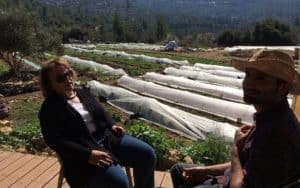
Naomi Eisenberger, executive director of The Good People Fund, makes a site visit to Kaima and its CEO, Yoni Yefet-Reich, in Israel. The program seeks to give direction and hope to kids at risk through organic farming, leadership development and business learning, and is one of the Israeli organizations supported by The Good People Fund. (The Good People Fund)


The fund works with a broad spectrum of organizations in the US and Israel. What is the common thread linking them together?

Clearly, the common thread is good people. I will often say to people who ask, there are a myriad number of good programs out there that need funding, but for us there has to be that individual, or that small number of people, who have vision and passion.

I can sit down with a potential grantee and know within five minutes if it’s going to be a “yes” or a “no” based on their personality and how they present themselves. Sometimes there’s too much ego and I’ll pick up on that right away. Generally speaking, these are just ordinary people. These people are our guides on how to live a good life.

People might be surprised to learn not all of the GPF grantees are Jewish, and that not all of their clients are Jewish.

We are an organization based in Judaism. We’re guided by Jewish thought. As much as we are commanded [by Judaism] to help everybody, we do. Obviously the programs in Israel are Jewish, but they need to be open to everybody. Some of them are clearly self-selecting, such as programs that deal with ultra-Orthodox women. Of course there’s not going to be any non-Jews in there.

I don’t think I’ve ever gotten a donation that said “Use only for Jews.” I have gotten donations that said “Only use for Israel,” or, “Don’t use for Israel,” but I think everybody understands we are here for everybody. We fund things that are Jewish, we fund things that are synagogue based and we fund things that are church based. We are ecumenical.

I have a tendency to want to help people who have fewer resources than others. It’s just how I was raised. It was what I saw at home. My parents were very involved as volunteers. My father was president of the synagogue and he was a volunteer fireman and he was president of his Kiwanis. It never dawned on me to do anything different, and I hope I have passed that on to my kids.
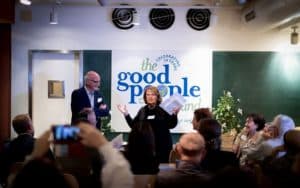
Naomi Eisenberger, executive director of The Good People Fund, addresses heads of grantee organizations in Israel at a 10-year anniversary gathering and celebration in February in Tel Aviv. (The Good People Fund)


In a headline driven culture where big donations and big organizations get the attention, can you speak to the philosophy of micro-philanthropy and how that can be a model for people looking to make a change?

I never look at the glass half full. I abide by the premise that small things can make a significant difference.

When someone asks me to explain the Good People Fund I use the starfish parable. There’s a grandmother and grandchild walking on the beach and there are a thousand starfish on the shoreline. The grandchild starts throwing them back in the water, one at a time. The grandmother says, “Why are you doing that? You’ll never get them all back.” And the kid says, “But it makes a difference to the ones that I did throw back.”

That’s how we look at this, changing one life at a time. That is always what guides me.

People who want to put their names on buildings are not going to understand us. We deal with modest sums of money. At tops our grants are $15,000 to $20,000. For small organizations that’s a good deal of money. We’re not dealing with people who have millions to give away.

The #GamAni movement has been described as a #MeToo movement among those doing Jewish communal work. Is that an apt description?

I’ll preface it by saying #GamAni is indicative of where I think we, as an organization, should be. I see us as partners with our grantees. So this young woman had just come back from coffee after meeting with a potential donor and he had accosted her. She didn’t know what to do. She felt horrible, she felt dirty. She reached out to me.

I felt personally tied to the issue because she was my grantee. So I started looking into whether anything had been done on harassment. I couldn’t let it go and I called Martin [of the Kaminer Foundation]. We put together a questionnaire and the responses absolutely raised the hair on the back of our heads like you would not believe.

The private #GamAni Facebook page allows a common place for people to share experiences. I know a few perpetrators have been identified, but they have not been dealt with yet. [Eisenberger declined to divulge names as the Facebook page is a closed group.]
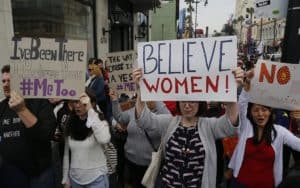
Participants march against sexual assault and harassment at the #MeToo March in the Hollywood section of Los Angeles on November 12, 2017. (AP Photo/Damian Dovarganes)


A very significant issue of sexual harassment in the Jewish world was uncovered, but what is happening is no different than what is happening on Wall Street, what is happening in the media, really what is happening everywhere.

But do I equate this with the #MeToo movement? No, and I’ll tell you why. I have a lot of concern about the #MeToo movement and the excesses of it. There have been a lot of people drawn and quartered who I think should not have been.

What progress has #GamAni made and what pushback have you received for it?

I apprised my board from day one and told them if you want me to step back I’ll step back. But, because we are part of the communal world I don’t see this as a disconnect for our mission.

I did have two donors who expressed displeasure that we are doing this. Both of them equated it with #MeToo and the excesses of #MeToo. I explained it overlaps with our work, and that I could not step away from this any more than I could step away from our other work. I was taught to be this way and this is the way I live my life.

For the most part the organized Jewish communal world has gone along with it. I think some of the organizations may not be going along happily, but they are going along because they saw the train has left the station on this.
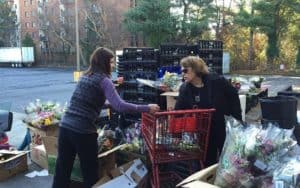
Naomi Eisenberger, right, executive director of The Good People Fund, helps in food rescue efforts of one of the group’s non-profit partners, Second Helpings Atlanta. (The Good People Fund)


One of the things we did was to bring some training to Jewish communal organizations, some of which are very small. Last December we had 12 New York based organizations for a daylong training. The ultimate goal was for them to develop their own policies. Most had none in place, or the policies weren’t adequate. It was uncharted territory for them.

There is a call for more women in leadership roles, but having women at the top doesn’t guarantee the culture will change. How do you really change the culture?

This is an evolution. I’m hoping by the time my 16-year-old granddaughter, or maybe my 12-year-old-granddaughter, reach the workplace they will start to benefit from what their grandmother was part of. When I look at myself, and think “How did you get here? What does it matter at 72?” First of all being a victim myself has driven me. That’s near the top. Also, I’m always looking for the underdog. It’s just who I am. It’s always where I’m going to go.

Could it have been professional suicide to do this [#GamAni]? Maybe, but I’d like to hope there are a few good people left in this world and I believe that there are. Truthfully, what I do every day is what keeps me going. There isn’t a bad moment in my day, and who has a job like that?
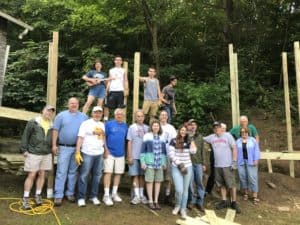

The Good People Fund announces Israel and US Grants

The Good People Fund (GPF) has announced nearly $1.5 million in Israel- and U.S.- focused grants as part of its mission supporting and advancing grassroots, community-based organizations meeting some of the most compelling and pressing societal challenges.

Across the spectrum of social and humanitarian needs – from poverty and hunger, to eldercare and youth-at-risk – the grants underscore GPF’s commitment to innovative, impactful work that improves and lifts lives and communities and are models for replication elsewhere.

Since its inception in 2008, Millburn, NJ-based GPF has directed nearly $11.3 million to more than 130 nonprofit organizations in Israel and the United States. Of the nearly $1.5 million announced today for the fiscal year that ended June 30, $1,008,033 will go to Israeli organizations, and $455,690 will be directed at programs in the United States.

The Good People Fund targets initiatives in key crucial areas, including: Human Needs; Inclusion; Health; Women’s Empowerment; Children and Youth Welfare; Elder Care; Hunger and Food Rescue; Alternative Healing of Body and Mind; Literacy and Education; Military and Veteran Welfare; and, Refugee Support.

A full list of new grantees appears at www.goodpeoplefund.org.

‘Love feeds the soul’ on tikkun olam trip to Appalachia

I doubt many people have ever heard of McRoberts, Ky. It’s a small, isolated town — population around 900 — smack in the middle of Appalachia, near the Virginia and West Virginia borders.

After a 12-hour drive from New Jersey, I arrived in McRoberts last week with a delegation of Jewish community service activists from Congregation B’nai Israel in Millburn, where I serve as rabbi. During our time there, our seventh year visiting McRoberts, we deepened our relationships and built on past seasons of engaging in tikkun olam.

One question I am often asked is: “Why Kentucky, when there are so many places closer to home that need help?” Because, I answer, it’s critical that we make a dramatic break from our comfort zones and gain exposure to people and places we otherwise would never encounter.

And now, at a time when the social fabric in our country is severely frayed, Jewish social service projects like ours contribute a small but essential “mending.”

In the post-Hurricane Katrina years, a delegation from our congregation went to New Orleans and the Mississippi Gulf region and, joining thousands of volunteers from Jewish communal organizations across the country, collectively made a significant impact. But it had always been my vision to develop a long-term and ongoing relationship with one place — one community — beyond the more predictable spectrum of Jewish service projects.

Naomi Eisenberger, executive director of The Good People Fund in Millburn, is an old friend and a willing collaborator. When I asked her advice, she suggested McRoberts, located in what may be one of the poorest counties in the nation.

So years ago, we went to scout the area, and I became reacquainted with the rural poor who, as a result of their geographic isolation and a rapidly changing economy, have almost no social or economic infrastructure; McRoberts, being in the middle of coal country, also has few jobs available.

We met middle-aged grandparents raising their grandchildren because the middle generation was caught up in the opiate epidemic. We met residents using water from streams polluted with toxic runoff from mines. We met people whose resilience in the face of adversity was as great as anything I have ever seen.

In 2010, our first corps of social service volunteers arrived in McRoberts. We set to work, repairing houses, painting buildings, cleaning streets and public parks, and unloading and distributing much-needed products from a 40-foot-long food bank truck.

That first year, we were met with resentment and little cooperation. Upon our arrival, the town hall, where we had arranged to store the food, was locked. The mayor, who had the key, could not be found. The forklift we needed was curiously unavailable. Few people would even talk to us. Still, we returned again and again.

One year, the food truck did not show; due to miscommunication, it was never loaded. Naomi and I put our heads together and sent our vans to three grocery stores in the area, 15, 30, and 45 minutes away, respectively. We bought $4,000 worth of peanut butter, pasta, tuna, diapers, and other staples.

The locals asked, “Why? Why are you doing this? The food truck didn’t come; it’s not your fault or responsibility.” I answered for the group: “In the Jewish tradition, when you promise food, you have to deliver — there are no excuses.”

That was when they learned we were Jewish. But more importantly, from that point on, we got enthusiastic cooperation in McRoberts. We had earned a measure of trust and gratitude.

After we returned home, I received a letter from a person in McRoberts, someone I never met; even now, years later, I don’t know who sent it. The letter read in part: “I will tell both of you something few people know about me — I am a victim of incest…. I left home at 18 and married a man that was also abusive…. I live in constant pain…I also lost a son.”

“With my past,” the letter went on, “[I am] a little leery of trusting people and believing people are good and caring. BOTH of you have proved that people that care about the well-being of others do exist….  No words could ever describe how very important that is to me. I am a better person for knowing you and I have you to thank for the healing of my heart and spirit.

“I told you this…so you can understand the impact you have had on my life,” she continued. “The food that you purchased fills the belly — but the love you share feeds the soul. To me, that means so much more…. There are a lot of people here without a lot of hope in their lives. They live day by day just trying to survive the best way they know how and then suddenly ANGELS appear…and they are reminded: Good people do exist.”

And so this year we again made the 12-hour trip to another existence. First-timers, as always, were blown away by what they saw. The situation in McRoberts is unique in their experience, and some of them came home depressed and perhaps a little angry. We will continue to talk about our mission, and some congregants will find that their time in McRoberts has changed them in ways they never imagined.

The most important lesson I have learned is that hope and respect for others are the greatest gifts you can give. That is a lesson sorely needed in these times.

Rabbi Steven Bayar is religious leader of Congregation B’nai Israel in Millburn.

Why Bigger Isn’t Always Better

Scrolling through the daily barrage of philanthropy-related news releases, I often encounter numerous articles from large foundations announcing prizes, summits and fellowships. Indeed, these are all noteworthy organizations doing significant and impactful work, but should donors looking to support nonprofits only look to large foundations and ignore micro-philanthropies? Are prospective donors aware of the benefits of working with a micro-philanthropy when it comes to impact and engagement?

Following a Different Path

As the co-founder and executive director of The Good People Fund, I believe that too often donors overlook organizations such as ours that specifically address the needs of these small grassroots efforts, who by their very nature lack the means to be visible to larger numbers of donors despite the effectiveness of their work. With grants totaling nearly $8 million during the past eight years and a modest infrastructure, I like to believe that we are changing the philanthropic landscape.

The Good People Fund is an organization that works exclusively with small grassroots nonprofits started by inspiring individuals committed to changing the world. In the past eight years, more than 150 grantees, all small to mid-sized organizations, have benefited from our insight and support.

Each operates with low overhead and on a personal scale, developing creative solutions that address poverty, hunger, disability, trauma recovery, social isolation and other significant challenges, but whose work would otherwise go unsupported. At The Good People Fund our vision is clear: Help donors do a maximum of good with each dollar spent by connecting donors with the Good Person (grantee) whose work best realizes their personal giving goals.

Emphasis on Direct Mentorship and Guidance

What makes our work both unusual and highly effective is the strong personal relationships we build with grantees. I strongly believe in our 4S model: Scope (focusing on programs that address a wide range of social needs), Screening (carefully vetting each prospective grantee), Supervision (mentoring and guidance continues well beyond the issuance of a check) and Speed (working efficiently and with minimal bureaucracy).

What we emphasize to both grantees and donors about our philosophy is that a newly established or a smaller scale nonprofit has their best chance of success if they can take advantage of the benefits of a personal connection; a mentor to guide them in addition to the shared experiences of other successful nonprofits. This connection to direct mentorship and guidance is too often overlooked by donors. We are very closely tied in to the grantees’ work in ways that larger entities can not be.

With so many years of involvement with small nonprofits, I find donors appreciate the strategic perspective we provide and grantees appreciate the unique way we handle their needs. We have established a deep network and general knowledge of the nonprofit world and take pride in facilitating partnerships, connecting people and programs, and offering guidance and expertise.

“I have been supporting the work of the Good People Fund since it began back in 2008,” explained one long-time donor. “I believe in its mission and have seen first hand how my donation can directly impact this work. They are attuned to what is important to me as a donor and I appreciate the guidance they provide in selecting to support an organization that shares in my values.”

Traditionally, funders donate, step away and perhaps ask for a report on how their funds were used. The Good People Fund works on a much more personal level and believes that our model could play an even more significant role in philanthropy today. It is not just about site-visits and grant reports; relationship building, hands-on support and acting as a partner, collaborator, advocate and sounding board for both donors and grantees is essential to our model’s success.

Naomi Eisenberger co-founded The Good People Fund in 2008 and became its first executive director. Follow @goodpeoplefund on Twitter.

Encore Stories

I am the co-founder and executive director of The Good People Fund where I discover, mentor and financially support grassroots organizations that respond in creative ways to society’s most intractable problems.

Together we focus on board development, fundraising, staffing, administration and more; all critical to the success of any organization. I challenge them to think realistically about how best to implement this growth.

I was professionally trained to be a high school U.S. history teacher, but I spent only a few years in that role before becoming a mom. I also worked as a plant doctor, used my love of cooking as a caterer, my needlework skills to build a needlepoint business and revived a tired family business selling men’s and boys’ clothing. Somehow, entrepreneurial opportunities always seemed to find their way to me.

My quest for meaning following a cancer diagnosis in 1991 led me to read books by Danny Siegel, a Jewish writer and founder of a small fund that supported small grassroots programs led by inspiring people. I was captivated by his philosophy about how we can each use our talents to make a difference and my second career calling became clear. In 1994, I became Siegel’s intern and eventually moved to full-time Managing Director.

When his nonprofit was no longer in operation, I could have retired at the age of 62 but, instead, saw a rebirth opportunity. With so many small organizations counting on us for support and so many donors excited about our focus, I decided to start over and brought together several people who believed in me and this work. Under my leadership, we formed a new nonprofit and began The Good People Fund in 2008.

The grantees I work with have all decided to dedicate themselves to a specific problem. One such organization/grantee is Unchained At Last, which provides support for women leaving arranged and forced marriages. Fraidy Reiss founded the organization in 2012 to help other women like herself.  I knew this organization needed support both professionally and financially; it addresses a serious issue previously ignored in our culture. Today it has grown to be the only nonprofit in the US dedicated to both helping women rebuild their lives, and promoting social and policy change to prevent forced marriage.

Reiss explains the impact GPF has had over the years this way: “They have never just handed over the check. Naomi became a trusted adviser and mentor, helping me to figure out when and how to start hiring other staffers, how to reign in a board gone wild, and which items to prioritize on a tight budget.”

Now that I myself have become that “older worker,” I can see even more clearly that nothing can replace experience and the wisdom that comes with it. How sad it is that we live in a culture which worships youth. How much better our world would be if we would embrace the contributions and experience of older workers. I have learned that with age I am more comfortable being forthright in my interpersonal relationships and more willing to share what life has already taught me. It is at once liberating and joyful!

Inspired By The Work Of Everyday Heroes, She Found Her Second Calling In “The Good People Fund”

A former teacher and local business owner, Naomi Eisenberger began a new quest for meaning following a cancer diagnosis in 1991 and a chance meeting with an author focused on everyday heroes who help  better the lives of others. Captured by a philosophy about how we can all use our talents to make a difference, Naomi invited him to speak at her synagogue, and her second career calling became clear.

Shortly after, she became a volunteer at this non-profit and eventually moved from a part-time employee to a full-time Managing Director role. When that organization closed with the founder’s retirement, she saw a rebirth opportunity. In 2008, she assumed the role of co-founder and executive director of The Good People Fund and demonstrated tremendous leadership capacity in evolving this new non-profit to where it stands today.

The Good People Fund (GPF) was founded to support small grassroots organizations(mostly volunteer-run) engaged in repairing the world. At the center of each program is a single visionary or a group of Good People who have chosen to dedicate themselves to fixing some societal issue. Each of them, in fact, can be considered an entrepreneur in their own right.

Naomi spends her time serving as a mentor, coach, resource, connector and lifeline to the grantees. Her work takes her from remote corners of the US to countries abroad where she gives a voice to programs and people that operate under the radar and work directly on the ground to ease poverty, hunger, disability, social isolation and other forms of human suffering. She lives and breathes this work “commuting” to a home office 20 feet from her bedroom.

Who Are Some Of These Good People
Jacob Sztokman is the founder of Gabriel Project Mumbai which works to foster health, nutrition, literacy and empowerment among families living in Mumbai’s slums. Barry Hoffner founded Caravan to Class with the goal of rebuilding the educational infrastructure in the villages around Timbuktu, Mali and Sub-Sahara, Africa. Erin Zaikis is the founder of Sundara which focuses on reducing preventable hygiene-related deaths and disease by creating sustainable soap recycling programs for underserved populations in India(read her inspiring story here) and now worldwide. Gloria Baker Feinstein founded Change the Truth which provides kids in Uganda, most of whom were orphaned by the AIDS epidemic, with food, scholarships, books, a library, music education, medical care and other essentials. Linda Smith founded Reading Village in Guatemala which empowers Mayan teenagers to serve as reading promoters in villages around the region to help eradicate illiteracy and lead their communities out of poverty.

Naomi’s efforts with these grantees in India, South America, Africa and with others throughout the U.S. and Israel exemplify how unique an organization she has built. She has inspired the visionaries behind each to persevere despite the challenges of running a small non-profit. She nurtures their good work and navigates them through crises, helping them gain solid footing with her wisdom and GPF funds. Naomi’s unwavering support translates into the lives of many vulnerable people changed for the better. She has inspired people to connect to The Good People that she holds out as role models, reflected by the $8,000,000 raised in 8 years. Grantees believe that GPF is more than just a source of money. They value the strategic perspective the Fund brings, in addition to its deep network and general knowledge of the nonprofit world. GPF takes pride in facilitating partnerships, connecting people and programs, and offering guidance and expertise.

More Than Just A Business
Naomi has a deep emotional connection to the stories of the Good People and their causes. “The grantees I work with all have unique problems and situations that need to be resolved. My business experience coupled with my creativity and love of networking allows me to offer them concrete advice on how best they can develop their work and operate with efficiency and transparency. For most of the programs we work with, there is a very strong personal relationship, and we’re with them through the good times and the rough days as well. Ultimately, our wish is that every program we support eventually outgrow us and flourish without our funds and support,” explains Naomi.

Traditionally funders donate and step away, but for her, it is highly personal. It is not just about site-visits and grant reports, but relationship building, hands-on support and being a partner, collaborator, advocate and sounding board. Since co-founding Good People Fund, she has helped steward more than 150 grassroots organizations with both grants and
guidance.

One grantee may have said it best: “Don’t try to save the world alone! Surround yourself with trustworthy advisers who are experienced in non-profit management and want to help you succeed.”

  • « Go to Previous Page
  • Page 1
  • Interim pages omitted …
  • Page 7
  • Page 8
  • Page 9
  • Page 10
  • Page 11
  • Interim pages omitted …
  • Page 18
  • Go to Next Page »

Primary Sidebar

Tzedakah Diaries

The Good People Fund is all about stories that share the goodness within each of us and the way that goodness can change the world, bit by bit. Read on and find out why we love our work, helping extraordinary people. . . .

  • When Our Good People Meet…

    February 13, 2026 10:45 am

  • A Year of Healing and Harvest at Ruca’s Farm

    February 13, 2026 10:40 am

  • Grantee in the News: Bagel Rescue

    February 13, 2026 10:33 am

  • Serving Up Soup—and Community—at Zumwalt Acres

    February 13, 2026 10:30 am

  • Snow Days are for ‘Konnection’

    February 13, 2026 10:23 am

Footer

Candid Gold Transparency Award Charity Navigator Four-Star Rating
Safety. Respect. Equity. — SRE Network Affiliate

Get Inspired

Get uplifting stories of how ordinary people are changing the world in extraordinary ways. Subscribe to our monthly newsletter.

Subscribe

Recent Updates

  • When Our Good People Meet…
  • A Year of Healing and Harvest at Ruca’s Farm
  • Facebook
  • Instagram
  • YouTube

Copyright © 2026 The Good People Fund, Inc. | All Right Reserved | Website by DoSiDo Design and Insight Dezign 26-1887249

Want more good news?

Sign up here for our newsletter!

Good News

Educators Newsletter

Join our Educators News list for updates on to receive updates on our programs and curricula:

  • This field is for validation purposes and should be left unchanged.
Get Inspired
Just add your name and email address and you are on the way to reading Good People’s stories that will inspire you!

"*" indicates required fields

This field is for validation purposes and should be left unchanged.
Name*
The Good People FundLogo Header Menu
  • About
    • Mission and Vision
    • Values
    • Plan for Good (Our Strategic Plan)
    • Our Story
    • Professional Leadership
    • Board of Trustees
    • Financial Information
    • Privacy Policy
    • FAQ’s
    • Contact Us
  • Our Grantees
    • New Grantees
    • By Program Focus
    • By Location
    • By Organization
    • Alumni Grantees
  • How to Help
    • Donate Now
    • Acknowledgement Cards
    • Planned Giving
    • Charitable Solicitation Disclosure Statement
  • Learning
    • Our Educational Philosophy
    • For Jewish Educators
      • Our Good Service Model
      • Grab ‘n’ Go Lessons
      • GPF Core Curriculum
      • B’nai Mitzvah Service Projects
      • Archival Materials
      • Ziv Tzedakah Curriculum
    • For Students
      • Tips for Good Service Projects
      • Other Resources
  • Media
    • Newsroom
      • Grantees in the News
      • GPF in the News
      • Press Releases
      • 10th Anniversary
    • Grantee Focus
    • Videos
  • Good News
    • Good News Stories
    • Executive Director Messages
  • Podcasts
  • Journal of Good
    • Journal of Good
    • Stories of Hope
    • Journal of Good – Prior Years