• Skip to primary navigation
  • Skip to main content
  • Skip to primary sidebar
  • Skip to footer
 
LOG-IN
DONATE NOW
SUBSCRIBE
The Good People Fund

The Good People Fund

  • About
    • Mission and Vision
    • Values
    • Plan for Good (Our Strategic Plan)
    • Our Story
    • Professional Leadership
    • Board of Trustees
    • Financial Information
    • Privacy Policy
    • FAQ’s
    • Contact Us
  • Our Grantees
    • New Grantees
    • By Program Focus
    • By Location
    • By Organization
    • Alumni Grantees
  • How to Help
    • Donate Now
    • Acknowledgement Cards
    • Planned Giving
    • Charitable Solicitation Disclosure Statement
  • Learning
    • Our Educational Philosophy
    • For Jewish Educators
      • Our Good Service Model
      • Grab ‘n’ Go Lessons
      • GPF Core Curriculum
      • B’nai Mitzvah Service Projects
      • Archival Materials
      • Ziv Tzedakah Curriculum
    • For Students
      • Tips for Good Service Projects
      • Other Resources
  • Media
    • Newsroom
      • Grantees in the News
      • GPF in the News
      • Press Releases
      • 10th Anniversary
    • Grantee Focus
    • Videos
  • Good News
    • Good News Stories
    • Executive Director Messages
  • Podcasts
  • Journal of Good
    • Journal of Good
    • Stories of Hope
    • Journal of Good – Prior Years
You are here: Home / Archives for Andrea Good

Andrea Good

    Episode 16: Crowd-funding to Help Israelis Facing Hardship

    November 23, 2020

    Ten Gav (Hebrew, “covering someone’s back”) uses a crowd-funding model and web platform to match donors with Israeli individuals and families facing hardship. Ten Gav is a Good People Fund grantee and its two founders, Naomi Brounstein and Vivi Mann, describe how technology and human connection can uplift lives and promote the Jewish practice of tzedakah.

    Filed under:

    Episode 15: Facing Down Anti-Semitism and Anti-Zionism on College Campuses

    October 29, 2020

    College campuses are unpredictable environments for Jewish students, with rising levels of anti-Semitism and anti-Zionism. TribeTalk – a Good People Fund grantee – prepares and empowers students to navigate through it. We’re with TribeTalk Co-Founders Michelle Black, Robin Friedman, and Jude Sydney … along with Emmet Klein, a college student and TribeTalk Fellow.

    Filed under:

    Bringing Some Relief to the Border, Amid Tragedy and Calamity

    September 24, 2019

    “El Paso Strong.”

    Those words on digital traffic boards along I-10 in this Texas city bordering Mexico couldn’t mask a pervasive sense of sorrow.

    The day before, 22 people of Hispanic origin were murdered, and 24 seriously wounded, while shopping in a Walmart. The shooter, a white nationalist racist, traveled over 500 miles and hunted down Hispanic people like prey in the store aisles.

    Just over 24 hours later, thousands of Texans held a solemn vigil at a sports field located near the crime scene. They heard speeches of solidarity from leaders, including rabbis, priests, imams and ministers.

    Local politicians spoke against hatred and about El Paso’s reputation as among the nation’s safest of cities.

    A Hispanic woman identifying herself as only Theresa shouted, “This is our Kristallnacht, this is our Holocaust,” and said her mother was a Crypto Jew from the Dominican Republic. Theresa said she had taught courses in Holocaust education in El Paso’s public schools.

    “This is just so painful,” she said. “It closely resembles what I believe happened to the Jewish people during the 1930s.”

    A day later, we met another Hispanic woman who knew all too personally the pain of gun crime.

    Lupita, a grandmother of three, entered the US at El Paso from Juarez, Mexico. She arrived with the children after her son was gunned down in a Juarez bar. Her daughter was also killed by gunfire in the same city. A third son, who entered the US in El Paso, is being detained in a federal camp in Louisiana pending his asylum application.

    The children were separated from her at the border, taken to New York, where they stayed until finally being returned to a small, run-down, largely Hispanic El Paso suburb.

    Rabbi Steven Bayar, JSurge Executive Director, and journalist Phil Jacobs met Lupita as well as many others impacted on both sides of the US-Mexico border. Their trip, in cooperation with The Good People Fund, focuses on bearing witness to the struggle migrants face leaving untenable situations in their home nations with the hope of settling in the States.

    Rabbi Bayar and Jacobs went from homeless shelters to meetings with El Paso community activists deeply involved in the migrant conundrum.

    At a visit to the Familias Triunfadoras community center, Bayar and Jacobs met the facility’s founder and director, Maria Covernali. She was converting an old adobe style post office into a place for computer education training, a play area for children and a family counseling center.

    This is where Lupita showed up one recent day, looking for work and a purpose. For $30 a day, Ms. Covernali hired her to help with clean-up chores. Lupita and her recently arrived grandchildren are living in a nearby church for free.

    “I had to leave Mexico,” she told JSurge. “I left everything behind, everything I had, including my house. It just wasn’t safe anymore. My son said that we will be okay here.”

    But she added that when the immigration officials separated her from her grandchildren, she was heart broken.

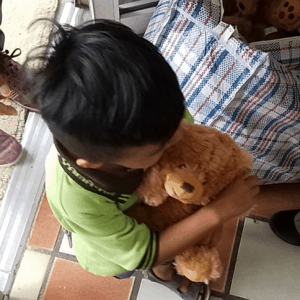
    On this day, with contributions from The Good People Fund, those same three children, two boys and a girl, received brand new, complete sets of clothing. The children will attend area schools.

    Lupita will continue to work at the community center … and await the status of a humanitarian asylum acceptance to the US, which could take months.

    For now, though, she said, “It feels good to smile.”

    By Phil Jacobs

    Filed under: Grantee Focus

    Helping to Rewrite Food Stories

    June 25, 2019

    She described some health challenges that she believes developed due to years of not-so-great eating habits, like drinking a couple of liters of soda every day and eating lots of fast food.

    But she could easily host her own healthy eating show now if she wanted, fluent as she’s become in the terminology and practice of controlling portions, reading and interpreting nutrition and ingredient labels, and getting the best healthy bang for every food dollar she spends.

    “I’ve come a long way and this program has been amazing and life changing for not only me, but for my family,” she said. “We are on the right path now.”

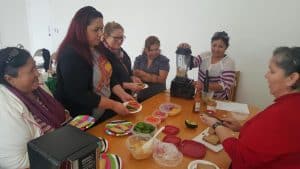
    This 40-year-old mother of three, who lives in New York City’s East Harlem, is one of about a dozen adults who graduated this past spring from a 12-week program designed to examine their food stories and equip them with the knowledge, motivation and support to alter default behaviors and make better food choices.

    The program is an initiative of FEAST (Food, Education, Access, Support, Together), a Los Angeles-based organization that not only advocates for food security for vulnerable populations, but also runs community-based wellness programs, like the one in East Harlem, to empower individuals and families, many of them low-income, to navigate what can be a confusing, defeating and fatal ecosystem of food and choice.

    FEAST, formerly known as Groceryships, is a grantee of The Good People Fund, which has supported the expansion of the wellness program and outreach to New York City.

    “This is a program that is changing lives and futures in a holistic way,” said Dana Rizer, FEAST’s executive director, who has a Master’s degree in Food Studies from New York University and co-authored the organization’s curriculum with FEAST founder, Sam Polk. “With Good People Fund support, we expect that our impact in New York will continue to grow.”

    The graduation in East Harlem in the spring was one of three that took place in New York, along with one in Brooklyn and one in Queens that collectively recognized 30 participants.  At PS 112, where the program took place and where most of the participants have children attending school, some students celebrated with their parents.

    One participant, a mother of two pre-teenage boys, said the program had done nothing less than enhance family dynamics and connection as she discusses food choices with her sons, goes food shopping with them, and makes eating together a more communal and regular affair.

    “We are having conversations at home now about what we are eating and why we are eating it,” she said. “And we are sitting around the family table more now sharing food and stories, and my older son wants to even do some of the cooking now. It’s been transformative in ways I couldn’t have seen.”

    To FEAST, that is, in fact, the entire point, recognizing that food can and should be a connector within families and communities, with the power to sustain, nourish and strengthen not just the person consuming it.

    The challenges are enormous, Rizer said, as people’s food choices are so often mired in culture, income status, fads, body image, family history, and, especially in economically challenged areas, all-important access.

    “Thanks to the success of food marketers and lobbyists, the overall system is set up so that people too often are misinformed, and fail to know how to make the right choices,” she said.

    “We are trying to break through that, not only through education but also through a deliberate support system that allows participants to set goals and come back every week to report back, celebrate successes and troubleshoot problem areas. Taken together, it makes an enormous difference with numerous ancillary benefits.”

    Tom Colicchio, the celebrity chef and restaurant owner, who has been an outspoken advocate in communities and on Capitol Hill for food justice issues and for the FEAST approach to food education, attended the East Harlem event to underscore his support for the grassroots work that is often necessary in economically challenged neighborhoods.

    “FEAST is the missing link in just so many ways here and elsewhere,” he said. “We are two generations removed from the Depression, when our grandparents and great-grandparents cooked everything.  Now we are around fast food and convenience stores and no one knows how to find the proper food and cook it.

    “But once you know how to cook, then you can stretch the dollar, know what healthy means, and make better choices and have an impact on yourself and your family and its health.  It’s a way to take control and take back a piece of your life. This program is making that happen.”

    Graduates of the East Harlem program said they will remain a support group beyond FEAST, yet another trickle-down benefit from their months-long class.

    “We have come together and supported each other through change,” said one. “There’s no telling what we can do to improve others’ lives too.”

    By H. Glenn Rosenkrantz, for The Good People Fund
    Filed under: Grantee Focus

    After Incarceration, Creating Hope and Future

    April 15, 2019

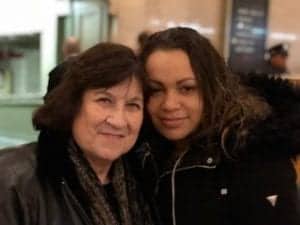
    Evie Litwok, above left, with Chasity, the first recipient of the Witness to Mass Incarceration Suitcase Project.


    She described a journey through a darkness most know nothing about – that of a professional Jewish woman navigating the netherworld of prison life and later reemerging into society to reclaim her dignity and purpose.

    Evie Litwok was at a New Jersey synagogue speaking at a social action Shabbat, and if her tale of a life bent to extremes by the criminal justice and penal systems created awareness through discomfort – and it did, judging alone from the air in the room – then she hit her mark.

    “I am gifted with being articulate, and so I have to tell this story,” she said. “I need to use all my strength to make people aware and force change.”

    That story is one of two decades fighting charges of white collar crime and culminating in two years in federal prisons – including a stint in solitary confinement. The experience introduced her all too intimately to social malignancies and human rights abuses festering and growing there, from homophobia to misogyny to racism and just about everything in between.

    “I’ve never been physically or emotionally the same since then,” said Litwok. “I have no serenity anymore. I have no choice but to channel what I’ve seen and experienced into activism. I am a baby of the civil and women’s and gay rights movements, and I’ve never checked my activism, and I’m not going to now.”

    The vessel of her impact is not only her own voice, but also the organization that she founded in 2015, Witness to Mass Incarceration (WMI). It is creating initiatives to raise public consciousness of conditions and abuses within the nation’s justice and penal systems and advocating for change.

    The group is one of the Good People Fund’s newest grantees and received a matching grant to bolster its capacities, reach and effect.

    Among WMI’s initiatives is a nascent but growing library of digital testimonies of formerly incarcerated individuals, giving a record of their experiences an archive and public platform. So far, about 25 people have sat for interviews.

    The focus of the testimonies, and WMI in general, is on women and members of the LGBTQ community – individuals Litwok said are most vulnerable to abuses in the justice and penal systems and beyond.

    “We must change the narrative from invisibility and victimization to empowerment through documentation, organizing and advocacy,” she said.  “Once someone sees the human faces of incarcerated people and hears stories, they will be more likely to support reform of a system that prioritizes punishment at every step.”

    The group just this year launched a new initiative – The Suitcase Project – that seeks to ease the move to civilian life for those just released from prison and transitioning psychologically and physically to realities and demands that they are too often unprepared to face even within existing social services networks.

    The project quite literally gives just-released people a suitcase with a laptop computer, a mobile phone with pre-paid minutes of usage, gift cards for groceries and clothing, and other essentials to help them build paths to productivity and self-worth.

    The impetus for it came from Litwok’s own experience. She left prison in 2014, her resources depleted, her social support network nearly non-existent, and with scant prospects.

    “Reentry is worse than prison,” she said. “Rarely is anyone waiting for you, rarely do you have housing, rarely do you have a community of support, or a job.

    “I was given $30 and sent on a bus to Port Authority in New York. I was homeless and penniless for 16 months.  I understood poverty for the first time in my life.”

    So far, two individuals leaving prison have received a suitcase, and a third will later this spring. Chasity, 33, began her journey back into society in January and said the Suitcase Project provides not only material support, but also represents and plants hope.

    “It is just hard to re-enter with absolutely nothing,” she said, adding that she is starting undergraduate studies in criminal justice.  “So the suitcase opens doors to positivity and moving in the right direction as opposed to just being overwhelmed and feeling forgotten.”

    The suitcase and its contents don’t come cheaply, and Litwok visits synagogues, like the one in New Jersey, to make the case for sponsorship of one, and in the process create a community of caring for those leaving prison and beginning new lives.

    “The greatest thing we can do for each other in this life is to form and nourish community in all of its forms,” she said.

    Speak with Litwok for any length of time and she will come to share the fact that her parents are survivors of the Holocaust, and that her closeness to that experience and her embrace of Jewish practice in prison informs and powers her passions and desire to make change.

    “The Holocaust didn’t end for us in 1945,” she said. “It was a framework for me growing up, and how I see the world and the ‘other,’ and is simply part of who I am and a driving experience. If we really believe all that we say about ‘never again,’ then we can never allow those words to lose their meaning and value, and always be working to snuff out injustices and abuses so they don’t become the norm.

    “I am up against the clock in my life at this point, and this is all that matters now. I don’t need to impress anyone for the rest of my life. I don’t care about making money. The driving Jewish values that we talk about don’t mean anything unless we make them mean something. I hope I’m doing that.”

    By. H. Glenn Rosenkrantz

    Filed under: Grantee Focus

    Designing Self-Empowerment

    February 25, 2019

    Mannequins here and there.  Swaths of fabric strewn across drafting tables.  Sewing machines and design sketches scattered about.   And lots of chatter and dark coffee.

    Yotstrot’s studio in Tel Aviv is a hub of creative energy so common in this city.  But this one is different.  Start talking to the women here, and you will see that besides designing fashion, they are creating new versions of themselves.

    “Here, I am learning and understanding that I am a person and not an object, and I can define myself on my own, and not through someone else,” said Lia, a transgender woman in her early 30s who is finding confidence, support and future at Yotsrot as she exits life in the sex trade.  “I have choices now.”

    Hofchot et Ha’Yotsrot, or Turning the Tables, was founded in 2011 as a force for women’s empowerment, a venue nourishing community and incubating economic security, advancement and transformation for Lia and others climbing out of the vortex of prostitution.

    Lilach Tzur Ben Moshe, Yotsrot’s executive director and founder, was a fashion editor at a leading Israeli online news site and used to commute each day past Tel Aviv’s Central Bus Station, where much of the sex trade takes place. She became disturbed and agitated at the exploitation and ugliness of it all to the point of action, using her own background in design to create a way out.

    “The greatest motivation for me was seeing in my own eyes, every day, women who are being used, sold, and exploited in prostitution,” she said. “It hit me in in my strongest point of power as a woman and I knew I had to do something to change it.”

    Since its establishment, Yotsrot has assisted more than 300 women with vocational training in design, sewing and pattern making in studios in Tel Aviv and Haifa.  Ongoing training in digital marketing – a skill necessary for any creative entrepreneur in the 21st century – is also offered with the support of The Good People Fund.

    But this is so much more than nuts and bolts training.

    In a world in which any sort of trigger can mean a skid toward unintended behaviors, for anyone, Yotsrot is a venue of mutual support and understanding to catalyze self-esteem and fuel dreams.   A network of social workers, counselors and others is committed to ensuring that everyone meets their own definition of success and future.

    For Lia, who came to Israel from Russia in the early 1990s, that means ultimately using her new confidence to uplift children through performance art.  For Or, originally from Ethiopia, it means using some of her newfound creative and technical skills to become a graphic designer.

    Yotsrot and everyone involved got a major shot of community validation last year during Tel Aviv’s fashion week, when Yotsrot designs got full runway treatment and exposure, worn by Israeli celebrities, including the wife of the city’s mayor.   Another public fashion show will take place in May.

    “Knowing every women and every journey she has made, showing on the most lighted stage there is that women in prostitution have so much to offer,” Ben Moshe said, “and seeing and feeling the excitement and the amazing effect on women, this was a moment of pure happiness and pride.”

    The organization has had other public moments, actively pushing for anti-prostitution legislation in Israel and being part of a coalition that helped pass a law criminalizing the hiring of prostitutes beginning next year.

    “After years of working towards changing public perceptions regarding the damages of prostitution, change has come,” Ben Moshe said.

    Back at the Yotsrot studio in Tel Aviv, Lia was fitting a dress she designed for the upcoming fashion show.

    “Here, we find out that we can become, and that we can create, and not just break things, including ourselves,” she said.  “And that’s everything.”

    By H. Glenn Rosenkrantz

    Filed under: Grantee Focus

  • « Go to Previous Page
  • Page 1
  • Interim pages omitted …
  • Page 15
  • Page 16
  • Page 17
  • Page 18
  • Page 19
  • Go to Next Page »

Primary Sidebar

Tzedakah Diaries

The Good People Fund is all about stories that share the goodness within each of us and the way that goodness can change the world, bit by bit. Read on and find out why we love our work, helping extraordinary people. . . .

  • When Our Good People Meet…

    February 13, 2026 10:45 am

  • A Year of Healing and Harvest at Ruca’s Farm

    February 13, 2026 10:40 am

  • Grantee in the News: Bagel Rescue

    February 13, 2026 10:33 am

  • Serving Up Soup—and Community—at Zumwalt Acres

    February 13, 2026 10:30 am

  • Snow Days are for ‘Konnection’

    February 13, 2026 10:23 am

Footer

Candid Gold Transparency Award Charity Navigator Four-Star Rating
Safety. Respect. Equity. — SRE Network Affiliate

Get Inspired

Get uplifting stories of how ordinary people are changing the world in extraordinary ways. Subscribe to our monthly newsletter.

Subscribe

Recent Updates

  • When Our Good People Meet…
  • A Year of Healing and Harvest at Ruca’s Farm
  • Facebook
  • Instagram
  • YouTube

Copyright © 2026 The Good People Fund, Inc. | All Right Reserved | Website by DoSiDo Design and Insight Dezign 26-1887249

Want more good news?

Sign up here for our newsletter!

Good News

Educators Newsletter

Join our Educators News list for updates on to receive updates on our programs and curricula:

  • This field is for validation purposes and should be left unchanged.
Get Inspired
Just add your name and email address and you are on the way to reading Good People’s stories that will inspire you!

"*" indicates required fields

This field is for validation purposes and should be left unchanged.
Name*
The Good People FundLogo Header Menu
  • About
    • Mission and Vision
    • Values
    • Plan for Good (Our Strategic Plan)
    • Our Story
    • Professional Leadership
    • Board of Trustees
    • Financial Information
    • Privacy Policy
    • FAQ’s
    • Contact Us
  • Our Grantees
    • New Grantees
    • By Program Focus
    • By Location
    • By Organization
    • Alumni Grantees
  • How to Help
    • Donate Now
    • Acknowledgement Cards
    • Planned Giving
    • Charitable Solicitation Disclosure Statement
  • Learning
    • Our Educational Philosophy
    • For Jewish Educators
      • Our Good Service Model
      • Grab ‘n’ Go Lessons
      • GPF Core Curriculum
      • B’nai Mitzvah Service Projects
      • Archival Materials
      • Ziv Tzedakah Curriculum
    • For Students
      • Tips for Good Service Projects
      • Other Resources
  • Media
    • Newsroom
      • Grantees in the News
      • GPF in the News
      • Press Releases
      • 10th Anniversary
    • Grantee Focus
    • Videos
  • Good News
    • Good News Stories
    • Executive Director Messages
  • Podcasts
  • Journal of Good
    • Journal of Good
    • Stories of Hope
    • Journal of Good – Prior Years